
On October 1, Mexico’s Andrés Manuel President López Obrador will finish a momentous six-year term. He will be handing over the National Palace to his handpicked successor, Claudia Sheinbaum. No one doubts that AMLO has been a transformative president. He upended Mexico’s political party system, dominated the media and the agenda, and yet left office with sky-high approval ratings. To his final days, he has also elicited strident critiques from those who see him as a threat to Mexico’s democratic and economic model.
In foreign affairs, however, AMLO’s transformative effects are less clear. He is oft-maligned as internationally ignorant, and even isolationist. He rarely travels abroad, and he made clear his focus would be at home. This has led, we think, to misinterpretations of the outgoing president’s worldview.
In a new article for Foreign Policy, Carsten-Andreas Schulz and I argue that AMLO’s legacy is better understood as an attempt to revive the republican internationalism of his hero Benito Juárez. We draw on our recent article in the American Political Science Review, “A Turn Against Empire: Benito Juárez’s Liberal Rejoinder to the French Intervention in Mexico.”
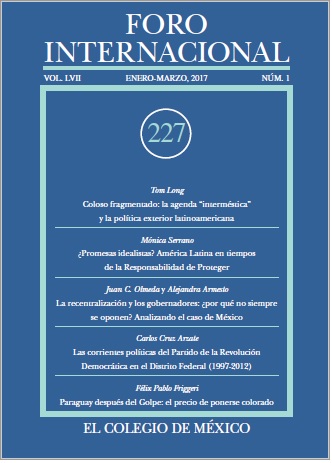 A new article is now out in Spanish in Foro Internacional, which most consider Mexico’s top academic International Relations journal. My piece, “Coloso fragmentado: la agenda ‘interméstica’ y la política exterior latinoamericana,” is the first piece in the January issue. The English title would be roughly “A fragmented colossus: The ‘intermestic’ agenda and Latin American foreign policy.” The official text is in Spanish, but I have included links to both Spanish and English versions and abstracts below.
 Homero Campa, La conexión México – La Habana – Washington: Una controvertida relación trilateral, Editorial Planeta Mexicana, 2014
 Tom Long, PhD