

Carsten-Andreas Schulz and I have an essay in the new issue of the Georgetown Journal of International Affairs. In it, we give a synthetic view of inter-American relations over the two centuries since Latin American independence. Against this historical backdrop, we focus on what changes within the hemispheric and at the global level will mean for U.S.-Latin American relations.
Article abstract
The two hundredth anniversary of the Monroe Doctrine provides an opportunity to make a somewhat contrarian point: U.S.-Latin American relations are not as unidirectional as commonly suggested. Though the international relations of the Americas have been characterized by the power disparity between the United States and its neighbors, it is misleading to imply that U.S. dominance equated to unilateral determination of inter-American relations since 1823. On one hand, the United States’ history of interventions, browbeating, and heavy-handedness is well known. Undoubtedly, asymmetry has played a significant role in shaping identities, interests, and designs of states in the Western Hemisphere. However, on the other hand, the disparity of power should not be understood as directly determining outcomes: the powerful state has not always prevailed; the weak have not always cowered. Instead, smaller states in the region have contested, cooperated, and co-constituted tin their relationships. In this piece, we aim to emphasize how Latin America has found spaces to pursue its interests in the interstices of asymmetry. Meanwhile, the United States has often fallen into an “insecurity dilemma,” exaggerating threats despite its position of much greater power and responding in ways that complicate cooperation.
Read “In the Interstices of Asymmetry: Two Centuries of U.S.-Latin American Relations”, open access, thanks to JHU Press and Project Muse.
It is time for a new U.S. approach: if Latin America is cast largely as a place from which ‘threats’ emerge instead of as a partner, the United States will alienate allies and struggle to build the security it desires.”
Cite: Tom Long and Carsten-Andreas Schulz. “In the Interstices of Asymmetry: Two Centuries of U.S.-Latin American Relations.” Georgetown Journal of International Affairs 25, no. 1 (2024): 132-143. https://dx.doi.org/10.1353/gia.2024.a934896.
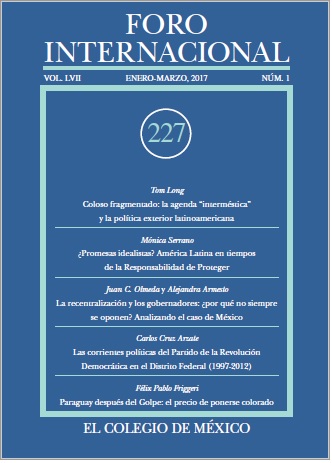 A new article is now out in Spanish in Foro Internacional, which most consider Mexico’s top academic International Relations journal. My piece, “Coloso fragmentado: la agenda ‘interméstica’ y la política exterior latinoamericana,” is the first piece in the January issue. The English title would be roughly “A fragmented colossus: The ‘intermestic’ agenda and Latin American foreign policy.” The official text is in Spanish, but I have included links to both Spanish and English versions and abstracts below.
 Tom Long, PhD