
The 1884-85 Berlin Conference is one of the best known and most infamous examples of European imperialism and the “Scramble for Africa.” How did Latin American states, the world’s first collection of post colonial countries, respond?
In a new article, with my brilliant co-author Carsten-Andreas Schulz, we examine this question. It’s out now in the Journal of Global History: “Seeing the Berlin Conference from the periphery: Latin American reactions to imperialism elsewhere, 1884–85″.
Although no Latin American states were invited, their diplomats paid close attention and offered strong responses. Carlos Calvo, perhaps the region’s most famous lawyer of the period, managed to attend. Their arguments reflected both resistance to imperialism and complicity in its logic. By tracing Berlin’s reverberations across multiple regions, we highlight the broader repercussions of late nineteenth-century ‘high imperialism’ and reassesses the nature of Latin American anti-imperialism.
On the one hand, Colombian diplomat Ricardo Becerra proposed a counter-conference to reject the principles advanced at Berlin. Scandalized by the proceedings and by the application of Berlin’s new colonial doctrines in the Pacific, he wrote: “If these are the notions of justice and international morality of the most enlightened statesmen of Europe, well-justified is the fear that tomorrow, when the Panama Canal opens, for example, that the same Germany or another power would apply to our deserted coasts of the Darien the doctrine subscribed in Berlin and already practiced with respect to the Carolines.” Brazil’s diplomat in Berlin expressed similar fears that the South American country might find itself victimized by imperial expansion.
On the other hand, the famous Carlos Calvo managed to attend the conference, drawing on his reputation in international law. Once there, he defended not the rights of Africans but those of Portugal’s traditional claims. Argentina, Brazil, and Mexico soon recognized King Leopold II’s Congo Free State, in an episode seemingly overlooked in the historiography.
The article is part of our AHRC-funded project on Latin America and the making of international order in the late nineteenth century. It draws on archival research in Argentina, Brazil, Chile, Colombia, and Mexico, as well as documents from France, Germany, the UK, and the US.
Check it out, open access.
Seeing the Berlin Conference from the periphery: Latin American reactions to imperialism elsewhere, 1884–85
Abstract: The Berlin Conference (1884–85) is widely studied for its role in fuelling European imperialism and legitimising the scramble for Africa. However, its global impact beyond Europe and Africa has received little attention, with Latin America notably absent. This article examines how prominent diplomats from Argentina, Brazil, Colombia, and Mexico interpreted the proceedings. In their view, Europe’s renewed expansionism in Africa—combining private adventurism, colonisation enterprises, and imperial statecraft—resembled the great powers’ incursions into post-independence Latin America. They feared that new criteria for staking colonial claims would endanger their states’ sovereignty over vast, remote territories. Yet, while opposing intervention, these diplomats embraced civilisational thinking and state-building projects that echoed Eurocentric racial hierarchies. Their arguments reflected both resistance to imperialism and complicity in its logic. By tracing Berlin’s reverberations across multiple regions, this article highlights the broader repercussions of late nineteenth-century ‘high imperialism’ and reassesses the nature of Latin American anti-imperialism.


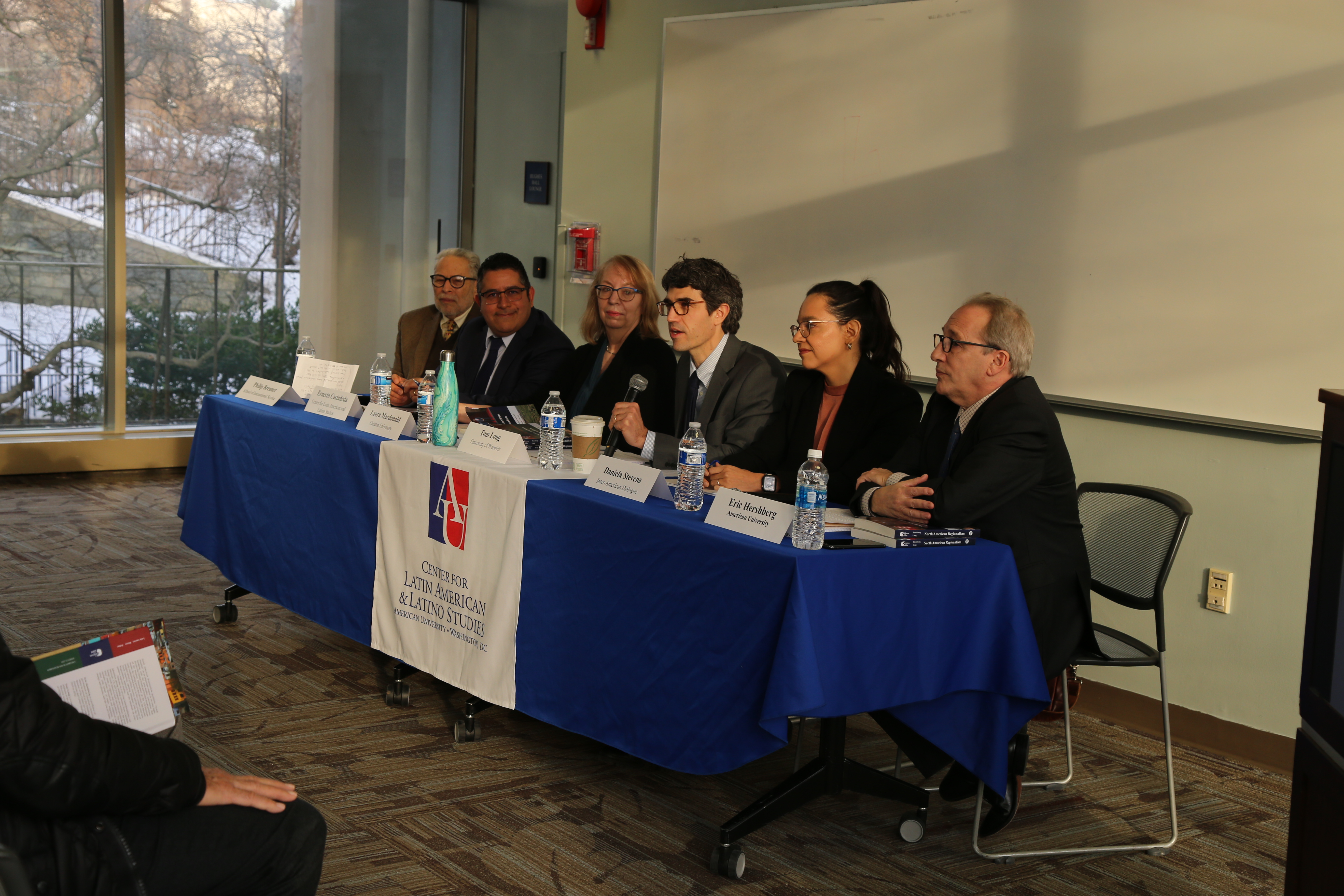


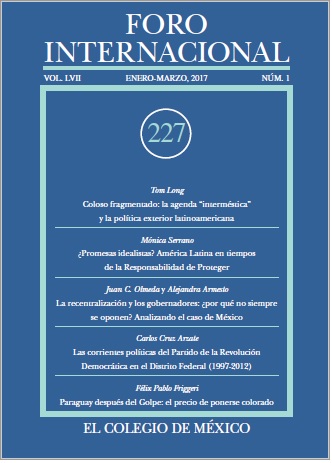 A new article is now out in Spanish in Foro Internacional, which most consider Mexico’s top academic International Relations journal. My piece, “Coloso fragmentado: la agenda ‘interméstica’ y la política exterior latinoamericana,” is the first piece in the January issue. The English title would be roughly “A fragmented colossus: The ‘intermestic’ agenda and Latin American foreign policy.” The official text is in Spanish, but I have included links to both Spanish and English versions and abstracts below.
 The immediate impact of “Brexit” on Latin America is to create additional economic uncertainty in what is already a challenging environment. Many Latin American economies have been hit hard by falling commodity prices. In the near-term, the referendum results will exacerbate that. Market turmoil will continue to drive up the US dollar, increasing borrowing costs for countries that are already in the red.
 The
The  Homero Campa, La conexión México – La Habana – Washington: Una controvertida relación trilateral, Editorial Planeta Mexicana, 2014
 Tom Long, PhD