Thanks to the Seminario de la Escuela de Gobierno at UniAndes for the invitation to present my work in progress at their seminar on April 25. I appreciate the turnout for the 8 am start!
Colombia updates
 I am keeping busy in Bogotá while on a British Council Researcher Links grant. With my colleage at Universidad de los Andes, Sebastian Bitar, we held a workshop/lunch with some of Colombia’s top scholars on foreign policy, the Colombian conflict, and the peace process. I have been lining up some interviews, meeting with other scholars, getting ready to give a graduate seminar and speak with a class of government officials, planning a public event, and co-drafting an article on Colombian foreign policy.
The School of Government, which is generously hosting me and providing me with an office and coffee, posted a nice piece on my visit.(Spanish).
They also released sign-ups for the talk I will be giving next week.
El 25 de abril @tomlongphd estará en el seminario de la Maestría en Políticas Públicas. Inscripciones: https://t.co/xRNsRZ0c3X pic.twitter.com/TovnsheSjq
— Escuela de Gobierno (@EGOBUniandes) April 18, 2017
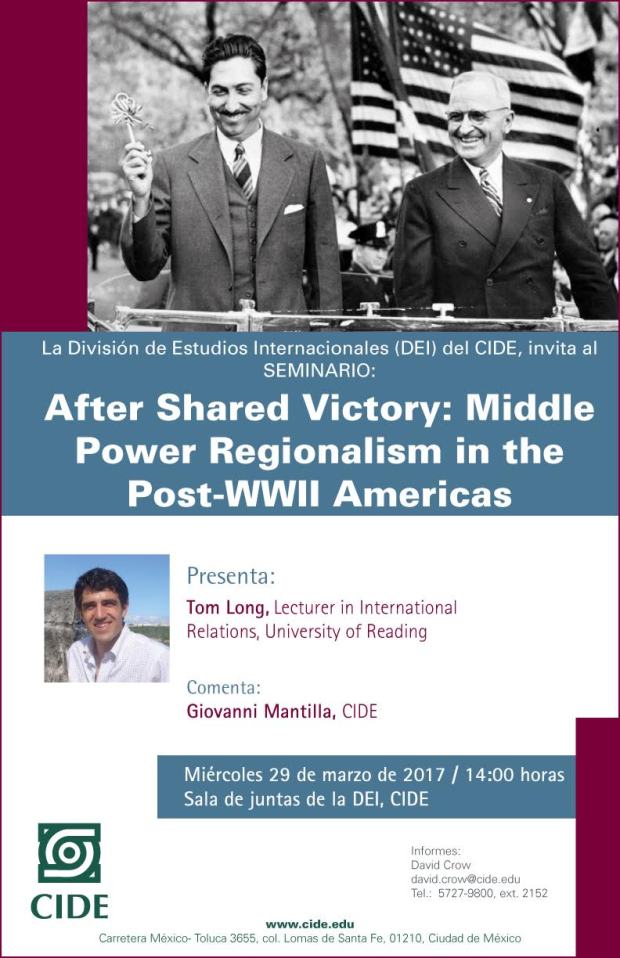
CIDE talk
New job: Warwick University
 In September 2017, I will start a new position in the Department of Politics and International Studies at the University of Warwick. The post is a permanent assistant professorship in Rising World Powers. I will be teaching a graduate seminar on rising world powers and an advanced undergraduate course on Latin American politics, development, and international relations. My research focus will continue much as before, though I think I will have some great opportunities to collaborate with colleagues around questions of regionalism and the dynamics of shifting power balances. The department is usually referred to as PAIS, which I plan to continually mispronounce as país.
Warwick is a relatively young university, but it is consistently recognized as one of the UK’s best research institutions. The whole university is generally in the top 10 overall, and PAIS is one of the standout departments. It is currently rated fourth by The Guardian for places to study politics and IR in the UK. In the last national survey (REF), the department tied Oxford for best research environment and was ranked 4th in research intensity. It has very large and active doctoral and postdoctoral programs. I’m also excited about the possibilities for working with colleagues from across Warwick. In particular, the History department has long been a place for great research on Latin America as well as in transnational Atlantic history. The university is very international; in fact, the new chancellor is Rt. Hon. Catherine Ashton, recently the European Union’s high commissioner for foreign policy and previously EU trade minister.
Warwick is located near Coventry, which is north of London (50 minutes by train to Euston) and quite close to Birmingham.
Here is some general information about the department.
Here my hiring announcement from PAÍS.
Article online: Foro Internacional
 A new article is now out in Spanish in Foro Internacional, which most consider Mexico’s top academic International Relations journal. My piece, “Coloso fragmentado: la agenda ‘interméstica’ y la política exterior latinoamericana,” is the first piece in the January issue. The English title would be roughly “A fragmented colossus: The ‘intermestic’ agenda and Latin American foreign policy.” The official text is in Spanish, but I have included links to both Spanish and English versions and abstracts below.
La versión del artículo en español se encuentra aquí.
An unofficial, pre-translation English-language version is available here.
Abstracts below the jump.
Research grant: Colombian foreign policy in the post-conflict era
 In collaboration with my friend and colleague Sebastián Bitar of Universidad de los Andes in Bogota, I have been awarded a “Researcher Links” grant from the British Council. The grant will fund research and workshops in Colombia over the next year to explore how the end of the conflict with the FARC (though of course tremendous challenges remain) might affect Colombia’s international role.
The plan for the project (from the application summary) is below:
Continue reading “Research grant: Colombian foreign policy in the post-conflict era”
Article online: Small States, Great Power?
 I am glad that my new article, “Small States, Great Power? Gaining Influence Through Intrinsic, Derivative, and Collective Power” is now available for online, full-text advance access at International Studies Review.
Abstract: In recent years, scholars have devoted increased attention to the agency of small states in International Relations. However, the conventional wisdom remains that while not completely powerless, small states are unlikely to achieve much of significance when faced by great power opposition. This argument, however, implicitly rests on resource-based and compulsory understandings of power. This article explores the implicit connections between the concept of “small states” and diverse concepts of power, asking how we should understand these states’ attempts to gain influence and achieve their international political objectives. By connecting the study of small states with more diverse understandings of power, the article elaborates the broader avenues for influence that are open to many states but are particularly relevant for small states. The article argues that small states’ power can be best understood as originating in three categories: “derivative,” collective, and particular-intrinsic. Derivative power, coined by Michael Handel, relies upon the relationship with a great power. Collective power involves building coalitions of supportive states, often through institutions. Particular-intrinsic power relies on the assets of the small state trying to do the influencing. Small states specialize in the bases and means of these types of power, which may have unconventional compulsory, institutional, structural, and productive aspects.
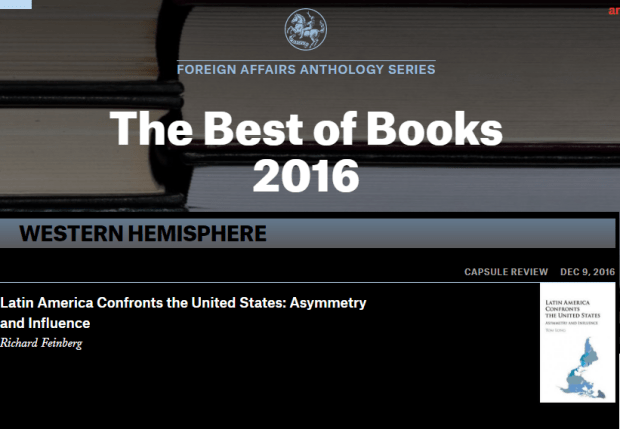
Foreign Affairs 2016 Book of the Year
It was pretty exciting to open Foreign Affairs best books list on Sunday morning and see Latin America Confronts the United States as one of the picks for the Western Hemisphere category! Here’s the full list (log-in required) and Richard Feinberg’s capsule review of my book.
UFOs and Argentina
Apparently, the most widely thing I will ever write was less than 140 characters on UFOs in Argentina in 1947.
I am currently hard at work in the Harry Truman Presidential Library in Independence, Missouri. While digging through diplomatic cables, I found a funny letter that a guy in Argentina sent to Harry Truman, giving his take on the new “fenemenum” of “flying plates” appearing in night skies around the world. So, I tweeted out a picture of the letter (below).
UFO sightings explained in this 1947 letter from a guy in Argentina to Harry Truman. The truth was in the Truman Library all this time! pic.twitter.com/6gGFQI1iBd
— Tom Long (@tomlongphd) December 7, 2016
And now, through another funny coincidence, I have learned that by the end of the day, Argentina’s La Nación, one of the country’s biggest papers, wrote an article about the 70-year-old letter and tweet. Unfortunately, the signature isn’t legible, so the clever writer isn’t getting his dues.
From the records, Truman never answered, which of course leads one to wonder…what was he hiding? Perhaps some very aerodynamic china…
Give to WOLA
I care about US-Latin American relations. A lot. Important relationships with our neighbors should not be held hostage to late night Twitter rants threatening to overturn good policy changes toward Cuba or to deport people from their communities after they escaped situations of poverty and violence; our neighbor’s societies should not suffer due to campaign rhetoric of building walls and or blowing apart economic and social relationships.

I also care about human rights in Latin America, the rights of migrants, and challenges to security in Latin America. The United States is often deeply implicated in these problems, and we should be a part of trying to improve them. I believe that solid research and dedicated, informed advocacy can make a difference on these issues. The Washington Office on Latin America has been doing this with great integrity for decades.
Because of that, I support WOLA. From here on out, any royalties from my first book, Latin America Confronts the United States, will go to WOLA. Those of you in academia know that’s probably not going to be a lot, but I feel it’s fitting that my research supports this cause in a small way.
 Tom Long, PhD