 I am keeping busy in Bogotá while on a British Council Researcher Links grant. With my colleage at Universidad de los Andes, Sebastian Bitar, we held a workshop/lunch with some of Colombia’s top scholars on foreign policy, the Colombian conflict, and the peace process. I have been lining up some interviews, meeting with other scholars, getting ready to give a graduate seminar and speak with a class of government officials, planning a public event, and co-drafting an article on Colombian foreign policy.
The School of Government, which is generously hosting me and providing me with an office and coffee, posted a nice piece on my visit.(Spanish).
They also released sign-ups for the talk I will be giving next week.
El 25 de abril @tomlongphd estará en el seminario de la Maestría en Políticas Públicas. Inscripciones: https://t.co/xRNsRZ0c3X pic.twitter.com/TovnsheSjq
— Escuela de Gobierno (@EGOBUniandes) April 18, 2017
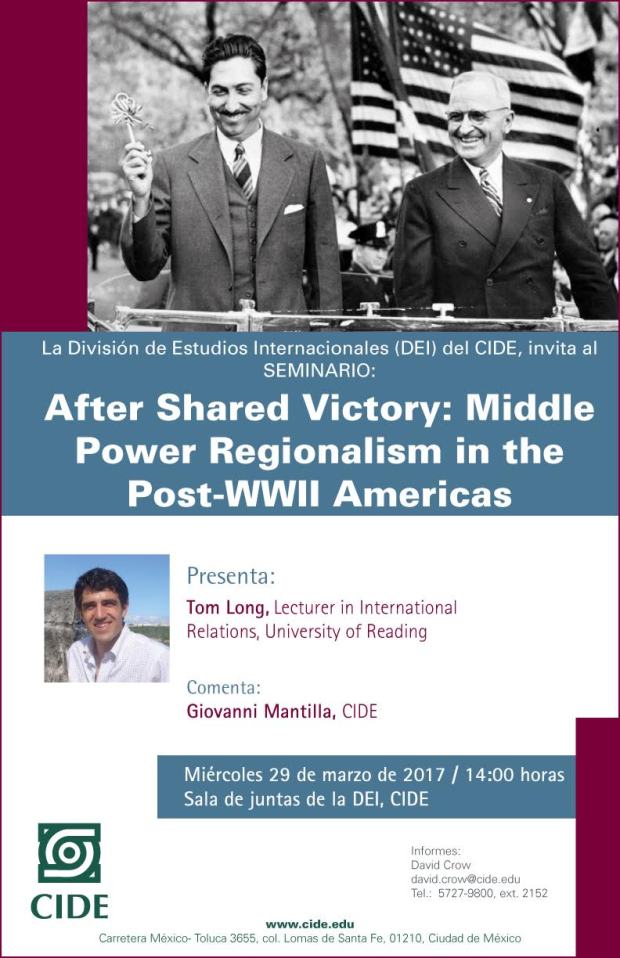
 In September 2017, I will start a new position in the Department of Politics and International Studies at the University of Warwick. The post is a permanent assistant professorship in Rising World Powers. I will be teaching a graduate seminar on rising world powers and an advanced undergraduate course on Latin American politics, development, and international relations. My research focus will continue much as before, though I think I will have some great opportunities to collaborate with colleagues around questions of regionalism and the dynamics of shifting power balances. The department is usually referred to as PAIS, which I plan to continually mispronounce as país.
 A new article is now out in Spanish in Foro Internacional, which most consider Mexico’s top academic International Relations journal. My piece, “Coloso fragmentado: la agenda ‘interméstica’ y la política exterior latinoamericana,” is the first piece in the January issue. The English title would be roughly “A fragmented colossus: The ‘intermestic’ agenda and Latin American foreign policy.” The official text is in Spanish, but I have included links to both Spanish and English versions and abstracts below.
 In collaboration with my friend and colleague Sebastián Bitar of Universidad de los Andes in Bogota, I have been awarded a
  I am glad that my new article, “Small States, Great Power? Gaining Influence Through Intrinsic, Derivative, and Collective Power” is now

 I will be joining the Oxford Latin America Centre’s weekly History seminar this Thursday (1 December) to present on my new and ongoing research on the recreation of the Inter-American order in the waning days of World War II.
  Tom Long, PhD