Book launch: American University

I will be presenting my new book at American University’s School of International Service. We will be in SIS 300 from 4-5:30 p.m. on November 4. Please join us! (Plus, I hear there will be coffee and snacks.) I am thrilled to be launching the book at the same place I started it (well, up a few floors).

Latin America Confronts the United States: Asymmetry and Influence (Cambridge University Press, 2015) will be out in just a couple weeks. But you can tell your librarians now!

Download the flyer here: Tom Long Book Discussion

Academic job market reflections

Earlier this week, I was asked to talk to PhD students at American University as part of a panel about the academic job market. I wanted to share a few thoughts from that panel for those who couldn’t make it. These observations are, of course, based on my own experiences, which probably aren’t typical. However, during that process, I also sought out advice from dozens of professors and colleagues. In particular, however, I want to focus on what the academic job market looks like for first-time applicants who are graduating from non-elite doctoral programs (that is, outside the privileged circle of ten or so programs from which the majority of new, tenure-track professors are hired), and especially those with degrees in International Relations. The market is tough, but it’s not hopeless!

Tom Long, Sebastian Bitar, Ryan Briggs
With my classmates, Sebastian Bitar and Ryan Briggs, now on faculty at Universidad de los Andes and Virginia Tech, respectively.

My experience, by the numbers:

  • I applied for about 75 positions over a three-year period. I would say that I was semi-selective about where I applied (that is, I wasn’t automatically firing off applications to every vacancy). I customized every one of those applications to at least some extent. Keep in mind, this takes a lot of time.
  • About 35 of those applications were to tenure-track or permanent jobs. About 20 were for fellowships and postdocs. About 15 were for visiting/term positions.
  • I received three interviews (and three offers) for permanent positions, though none was at a traditional academic institution in the United States. Two were abroad. I was interviewed for one postdoc, also abroad (no offer). I interviewed for four visiting/term jobs (two offers, including my alma mater in odd circumstances).

My thoughts:Continue reading “Academic job market reflections”

Job: University of Reading

Starting in January 2016, I will be a Lecturer in International Relations in the School of Politics and International Relations at the University of Reading. Marta and I will be moving to the United Kingdom later this year. We have a lot to learn about life in England, and I am still figuring out some aspects of the UK academic system. However, here are a few points about the city, the university, and the position.

Continue reading “Job: University of Reading”

Book update: Proofs sent!

LatAm Confronts-title pageJust a quick update on the progress of my first book, Latin America Confronts the United States. I just sent the final round of proofs to the publisher, Cambridge University Press. Including this project’s beginning as a dissertation, I have been working on it since early 2011. It is now out of my hands…until the first copies are quite literally in my hands. That process included fieldwork trips to Argentina, Brazil, Colombia, Panama, and Mexico. Thanks for all the support along the way! The book aims to provide a new look at U.S.-Latin American relations by focusing on some crucial moments from the post-WWII period.

As a very rough guide to the contents:

Ch. 1: Highlighting Latin America in studies of U.S.-Latin American relations
Ch. 2: Operation Pan-America, a Brazilian precursor to the John F. Kennedy’s Alliance for Progress
Ch. 3: Panama Canal Treaty Negotiations, with a focus on Panama’s strategy.
Ch. 4: North American Free Trade Agreement and Mexican foreign policy
Ch. 5: Plan Colombia and U.S. counternarcotics policy
Ch. 6: Latin American influence in a context of asymmetrical power relations

The book is available for pre-order on Amazon now. The hardcover price is steep, and the paperback won’t be out for a while. However, if you could ask your library to place an order, that would be great!

Second GOP Debate in 140 words

It seems some people don’t have three hours (or sufficient antacids) to watch the horde of Republicans candidates joust whilst standing in front of Boeing 707. To save you time, I have summarized the GOP Debate in a 140-word public service announcement.

Trump: I’m so great, I don’t need to know anything!
Carson: I hope I sound logical by comparison.
Fiorina: I’m here! On the big stage! Now I will answer every question! {PRINTER ERROR}

Jeb!: I’m not my brother, but my brother’s not so bad.
Rand: Oh my god…am I the reasonable one?
Kasich: I did lots of things! Now let me take credit for Bill Clinton’s accomplishments.
Rubio: The reason I am such a bad senator is because I’m anti-establishment. Now make me president so I can bomb stuff!
Christie: Pay no attention to the looming indictments…
Cruz: Plannedparenthoodplannedparenthoodplannedparenthoodplannedparenthood
Huckabee: I am the Kim Davis candidate!
CNN: You’d all be better than Hillary. Now tell us how you’d be 80% as good as Reagan. Then tell us your favorite flavor of jelly bean. Hint: The only correct answer is “freedom.”


P.S.: You might think that I forgot Scott Walker. But actually Scott Walker cut Scott Walker out of the post because he’s in favor of smaller posts. And he did it in a blue state.

Article in The National Interest

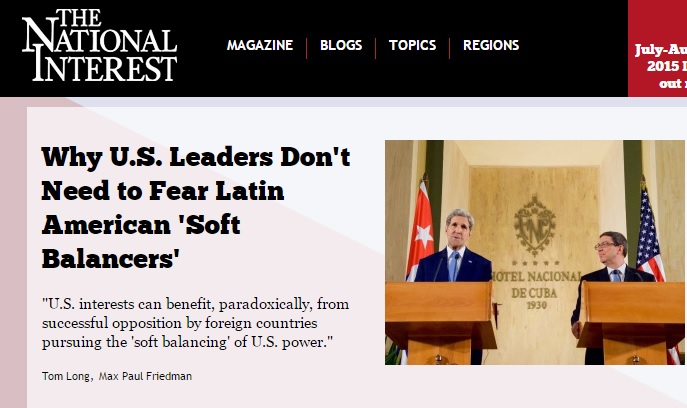
My new policy piece with Max Paul Friedman is online at The National Interest: Why U.S. Leaders Don’t Need to Fear Latin American ‘Soft Balancers.”


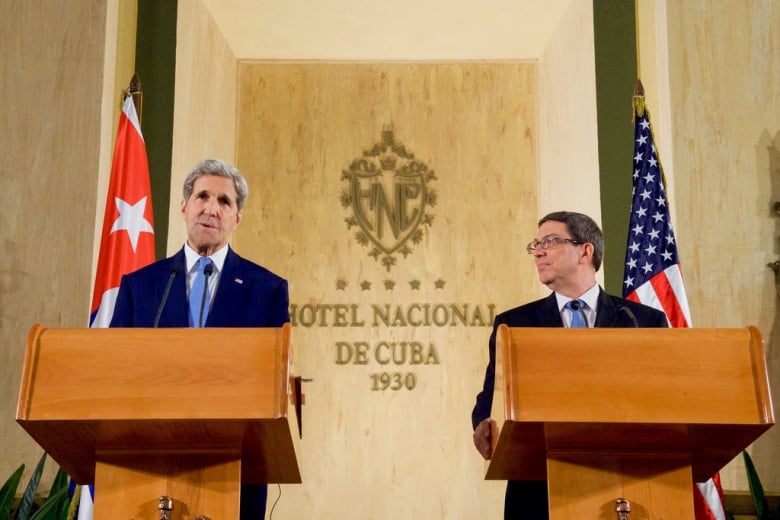
From the article: “Commentators have largely overlooked the important role Latin American diplomacy played in pushing Washington to change its fifty-six-year-old policy. This is a mistake, because Latin America’s role in influencing U.S.-Cuban relations holds larger implications for how the United States views diplomatic opposition from Latin America and elsewhere. During the last two decades, Latin American states undermined the legitimacy of Washington’s policies, raised their costs and pressured for a new approach. As Kerry noted more diplomatically in his press conference with his Cuban peer, “I thank our friends from around the hemisphere who have urged us—in some cases, for decades—to restore our diplomatic ties and who have warmly welcomed our decision to do so.” Cuba was more than a symbolic issue. The embargo’s unilateralism, and the extraterritoriality with which it was often implemented, damaged Latin Americans’ interests and offended their commitment to the principle of national sovereignty. For the United States, the opening to Cuba improves the U.S. position vis-à-vis rising Chinese influence by creating new investment opportunities and enhancing U.S. prestige. The dramatic policy change, made under Latin American pressure, is the most recent example of how U.S. interests can benefit, paradoxically, from successful opposition by foreign countries pursuing the “soft balancing” of U.S. power.”

Read the rest at The National Interest.


Op-ed: U.S.-Cuba relations will pay dividends in W. Hemisphere

With John Kerry in Havana today, Max Friedman and my op-ed in the Orlando Sentinel argues that this stroke of diplomacy begets wider benefits for the United States in the Western Hemisphere.

From the Sentinel:

On Friday, Secretary of State John Kerry will raise the flag over the U.S. Embassy in Havana. His visit caps the new trend. Diplomacy is back in the Americas. The secret talks that led to the re-establishment of U.S.-Cuban diplomatic relations are just the highest-profile example. For years, Latin American leaders have pressured and cajoled the United States to change its Cold War policy on Cuba. Finally, the Obama administration listened. Having done so better positions the United States in the hemisphere.

Read the rest at the Sentinel.

Soft Balancing in the Americas

Update: The new issue of International Security is now out, and the article is available through the journal. Our article, “Soft Balancing in the Americas,” is still free and ungated for a few weeks.

_______

From the newest issue of International Security, here is my new article with Max Paul Friedman. It is temporarily online free and ungated, courtesy of the Belfer Center.

Soft Balancing in the Americas: Latin American Opposition to U.S. Intervention, 1898–1936

Abstract:The concept of soft balancing first emerged in analyses of other countries’ attempts to counter U.S. primacy through nonmilitary means after the end of the Cold War. Soft balancing is not a new phenomenon, however. In the early twentieth century, Latin American states sought to end the United States’ frequent interventions in the region by creating international norms against military intervention.

1943 ... good neighbor policy


Cuando EU escucha a América Latina

Tom Long y Max Paul Friedman
Publicado por El Universal (México)
20 de julio 2015

Embajada de Cuba en Washington, D.C. Photo credit: ABC News

Este lunes la bandera cubana será izada en una casona de la calle 16 de Washington,  D.C.  Poco después, el secretario de Estado John Kerry viajará a La Habana para abrir la embajada estadounidense en la isla. Estos hechos representan la culminación de un notable giro en las relaciones entre Cuba y Estados Unidos. Sin embargo, la nueva era de la relación no es un triunfo de negociadores secretos o una estrellita en el legado del presidente Barack Obama. Su administración no está respondiendo sólo a cambios demográficos en Florida, está actuando además como consecuencia de un esfuerzo latinoamericano —iniciado hace décadas y últimamente exitoso— para modificar la política de Estados Unidos.

Seguir leyendo en El Universal…

Listening to Latin America

Tom Long and Max Paul Friedman
Originally published in Spanish in Mexico’s El Universal
July 20, 2015
Thanks to El Universal for permission to publish the English original.

The “new” U.S. embassy in Havana, beyond the flagpoles of the Tribuna Anti-imperialista

On Monday, the Cuban flag will be raised above a stately mansion on 16th Street in Washington, D.C. Not long after, Secretary of State John Kerry will travel to Havana to open the U.S. embassy there. These events represent the culmination of a remarkable turn in U.S.-Cuban relations. However, the new, developing U.S.-Cuban relationship is not just a triumph for secret negotiators or a gold star in President Obama’s legacy. The Obama administration dramatically was not only heeding demographic shifts in Florida. It was responding to a decades-long, and ultimately successful, Latin American effort to change U.S. policy.

Cuba was only the latest example where Latin American governments sought to limit the unilateral and arbitrary use of U.S. economic and military power. U.S. policymakers often bristle when their policies face opposition from Latin America. This is unfortunate. When the United States takes its neighbors’ concerns into consideration, the resulting policies are often more beneficial for everyone.Continue reading “Listening to Latin America”