New article: Public views of North America

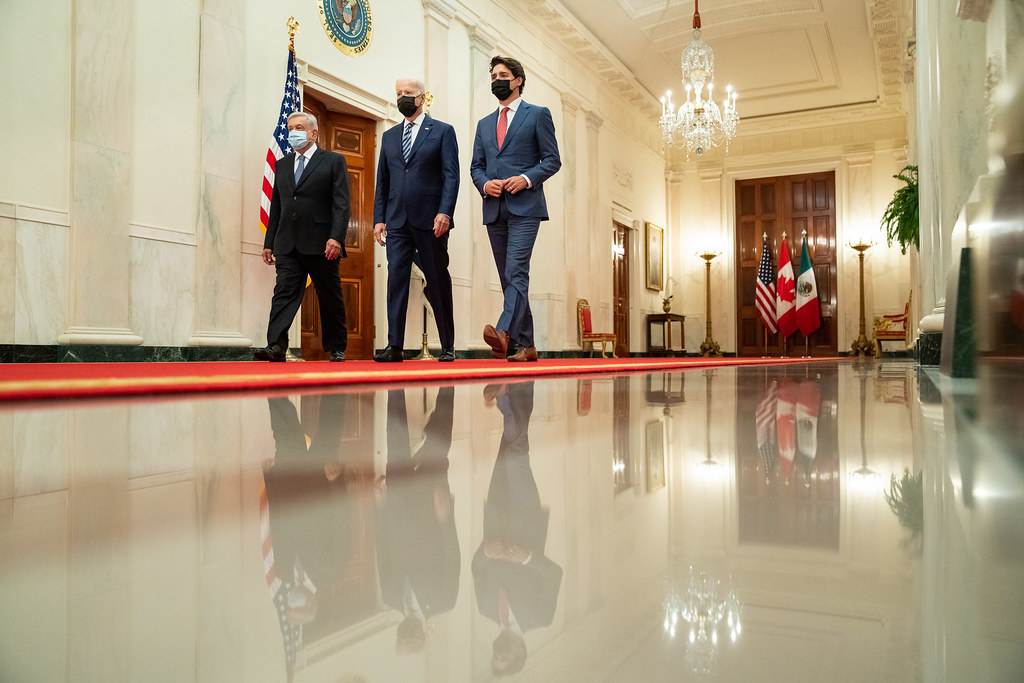
The North American Leaders Summit resumed after a five-year hiatus in November 2021.

Our new research article, “Issue-Areas, Sovereignty Costs, and North Americans’ Attitudes Toward Regional Cooperation,” has been published in the open-access journal Global Studies Quarterly.

The article results from a long-running collaboration with Malcolm Fairbrother of Umea University in Sweden (formerly of Bristol University in the UK) and Clarisa Pérez-Armendáriz of Bates College in Maine. We met and started working together through the Robert A. Pastor North American Research Initiative at American University, which I have been co-coordinating since 2015.

Our article examines public opinion in Canada, Mexico, and the United States regarding cooperation in North America. Normally, studies of public opinion on regionalism either ask for people’s views of trade integration or of a specific regional agreement or organization (NAFTA, the EU, Mercosur, etc.). But we assessed polling data that do something different, also asking people about their views of cooperation on six different issue-areas: energy, border security, economics, currency, environment, and defense. The surveys ran in 2013 and were overseen by Miguel Basáñez, Frank Graves, and Robert Pastor, who I was assisting at the time. Thanks to Miguel and Frank for generously sharing the full datasets! Given the rather dated nature of the survey, we’re not aiming to provide breaking news about levels of support today (generally, support for trade and other cooperation in North America is high unless you say “NAFTA” in which case it drops and polarizes … though this effect was most pronounced in 2016-2017). Instead, we are trying to understand specific features of how people view regional cooperation more generally.
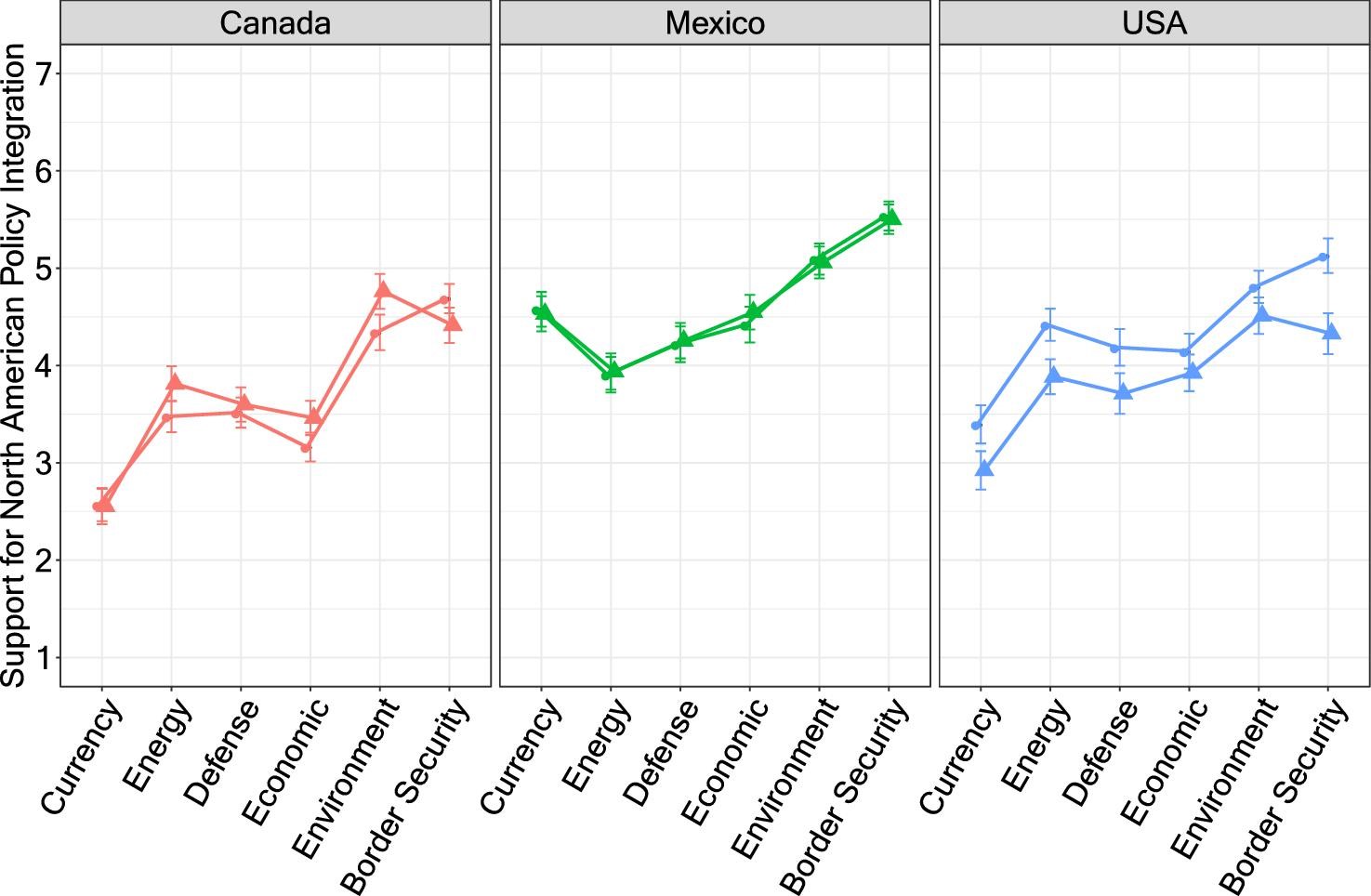
What the survey shows is quite interesting. People’s opinions of where they would like more regional cooperation differ quite a lot depending on the issue, and the differences are bigger than cross-national differences on trade. Generally, there is not a big difference in whether people prefer bilateral or trilateral cooperation. We go into different possible explanations for this in the paper, including individual-level correlates. But we think there are national-level patterns that result from assessments of whether one’s country is likely to benefit from cooperation. Those calculations take into account risks and benefits caused by divergent national capabilities. There are also some really interesting, issue-specific patterns. For example, Mexicans are supportive of cooperation on currency; US and Canadian respondents, not at all.

The abstract is below, and the paper is at the link.

Abstract
Studies of public opinion toward regionalism tend to rely on questions regarding trade integration and specific regional organizations. This narrow focus overlooks dimensions of regionalism that sit at the heart of international relations research on regions today. Instead, we argue that research should explore public preferences with respect to regional cooperation in different issue-areas. We find that people’s views of regional cooperation in North America diverge from their attitudes toward trade integration alone. Using data from Rethinking North America, an untapped public opinion survey conducted in Mexico, Canada, and the United States in 2013, we show that although country-level attitudes toward trade integration in North America were similar, preferences for regional cooperation varied by country depending on the issue at hand. We propose that attitudes are shaped by citizens’ perceptions of the asymmetric patterns of national-level benefits and vulnerabilities created by regional cooperation. Generally, respondents favor cooperation where their state stands to gain greater capacity benefits and oppose it where cooperation imposes greater costs on national autonomy. For policymakers, this multifaceted approach to regionalism sheds light on areas where public preferences for regional cooperation might converge. Future research that disaggregates various aspects of support for regional cooperation should help integrate the study of public opinion with “new” and comparative regional approaches that emphasize the aspects of regionalism beyond trade and formal institutions.

Ukraine and Latin American diplomacy

With a few notable exceptions, most Latin American diplomats sharply condemned the Russian invasion of Ukraine. This might seem obvious given the outcry in the United States and Europe. But amidst Russian outreach (vaccines, military kit, propaganda, and some cash) and the fraying of ties with the United States, having only four Western Hemisphere countries abstain in the UN reflected substantial support for Ukraine’s position.

Why was this support so wide and, often, vociferous? In a new policy essay in Global Americans, Carsten-Andreas Schulz and I argue that the invasion contravened some of the region’s most fundamental diplomatic norms and practices–what we call republican internationalism.

Comments welcome!

Publication day!

Early reviews of A Small State’s Guide to Influence in World Politics

March 4 is the official US publication day for my new book! The book has been available for Kindle for a few days. Now it should start shipping in hardcover and paperback in the United States. Due to printing delays, the UK and European release is set for May.

In the meantime, I am happy to share some kind comments for folks who reviewed advance copies of the book, in the gif above.

You can find the book…
Via Oxford University Press
Via Amazon
Via Bookshop
Or order from your local bookseller!

Book brief: Black Spartacus

In addition to flogging my own book, I have been meaning to write a few words about books that I’ve recently read and found interesting. Nothing as structured or formal as a review or even a book report, but perhaps a way to highlight some recent scholarship and maybe even some fiction.

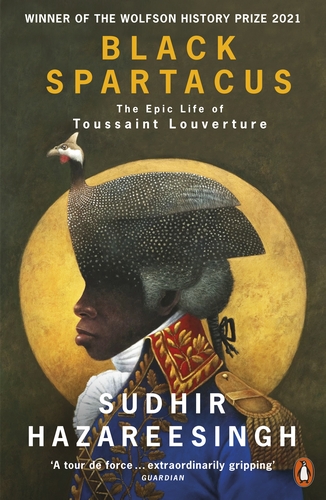
For the first “book brief” I want to mention a new book I’ve just finished, Black Spartacus: The Epic Life of Toussaint Louverture by the historian Sudhir Hazareesingh. It’s published by Penguin and intended for academic and non-academic audiences. It’s been widely acclaimed, including winning the prestigious Wolfson History Prize.

Toussaint is indeed a fascinating figure; despite his influence in Haiti, the wider Caribbean, and for many African Americans in the nineteenth and twentieth centuries, he does not get much attention in how history is taught in the United States–something that goes for the Haitian revolution and independence generally. As Hazaraeesingh indicates, following CLR James and others, that’s not a coincidence. Haiti’s 1791 slave uprising and eventual 1804 independence as a free black republic terrified slave owners in the US and the still-colonized and slaveholding Caribbean. Haiti was less forgotten than erased from how history is taught.

No one played a larger role in that struggle than Toussaint. Born into slavery, Toussaint gained freedom and then used his position and incredibly physical and mental attributes to become a leader of a revolt, then a revolutionary general and leader. He was a prolific correspondent, which allows Black Spartacus to offer an incredibly detailed and richly sourced picture of Toussaint and his military and political campaigns against the British (who sought to conquer Saint Domingue and reimpose slavery) and the Spanish (who ruled the slaveholding colony of Santo Domingo, now the Dominican Republic).

Toussaint was certainly heroic, and Black Spartacus does a tremendous job of highlighting those qualities and feats as a leader, strategist, and politician. For a “trade” book, it’s a pretty academic read, though a worthy one. I certainly learned a tremendous amount about Toussaint’s life and the road to Haitian independence. The book also acts as a reminder of the many reasons why Haiti deserves more attention in the United States’ own history.

During the period between the slave revolt and independence, Saint Domingue grew increasingly autonomous under Toussaint, but it was still part of the revolutionary (and then Napoleon’s) French empire. During that French interregnum, the United States was quite warm with Toussaint and even supplied him naval support and arms to counter revolts. This was, in large part, to balance British power. Once Napoleon turned against Toussaint and invaded to reestablish control and slavery, that changed. After a bloody campaign, Toussaint was exiled to France and left to rot and die alone in a French jail. In an act of wanton cruelty, he was denied access to friends or family at the end of his life. The clear and present French plan to bring slavery back to a population that had won its freedom by force of arms unified opposition and sparked a general uprising. Haiti gained independence without Toussaint. His successors led an insurgency that defeated the world’s most powerful country at that time; the United States took advantage of Napoleon’s crumbling imperial plans by completing the Louisiana Purchase. Though its expansion owed Haiti a great deal, it shunned and excluded the second independent country in the Western Hemsiphere. But for many in Latin America, Toussaint would be an inspiration and Haiti a direct source of support (in the case of Simón Bolívar) in the independence wars the spread after 1810.

By focusing on Toussaint as “the first Black superhero of the modern age,” my feeling was that the book left some of Toussaint’s fascinating contradictions underexplored. Toussaint was a dedicated republican, but he did not see that as contradicting the idea of staying in the French Empire where Saint Domingue would remain an unequal colony. Likewise, Toussaint seemed to have less interest in core republican ideas about division of power; his was a praetorian and often authoritarian republic. Toussaint sought to impose controls over social life, including strict ideas about Catholic marriage, though he appears to have kept mistresses all over the island. Toussaint wanted to transform the economy, but remained tied to a system of plantations; where Black ownership of these increased, it appears to have often favored the well-connected and the military.

These contraditions don’t necessarily take away from his heroism. At times, his contradictions responded to constraints in a pragmatic way. Toussaint clearly had a solid grasp of international relations, and he seems to have intuited the problems an independent Haiti would face in a hierarchical, racist, and imperial international society. After 1804, both Europe and the US cut off Haiti. Economically and socially, it paid a great price, on top of the devastation caused by an invasion and years of internal and external conflict. The US would only extend recognition during the US Civil War; France would only do so when promised a massive indemnity. Having fought France to end slavery and become free, Haitians had to pay for that a second time.

That’s more than I intended to write, but obviously there is a lot here. Very much worth the read!

Book (almost) out now!

My second book, A Small State’s Guide to Influence in World Politics, is now available for pre-order in the United States! The book will be released simultaneously in hardcover and paperback.

According to Oxford University Press, the book will ship on February 18 in the USA; it should be available worldwide as an ebook and by March 4, as well as in print via Amazon and other US booksellers. Due to global supply chain delays (really), the book probably won’t be available in print in the UK and Europe (and some other global markets) until May.

So, you may get a copy before I do!

Latin America at Warwick Event

The Latin America at Warwick Network (LAWN) is hosting our 2022 kickoff on 1 February, with history Professor Benjamin Smith presenting his new book. We’ll also be hearing from Warwick graduate students from History, Business, and Film Studies about their research, and we’ll talk about LAWN activities and plans for the year. If you’re in the area, join us. If not, I’d encourage you to take a look at Ben’s book–available from all fine booksellers!

Book review: Latin America in Global IR

I’ve written a review of the brand new edited volume from Amitav Acharya, Melisa Deciancio, and Diana Tussie, Latin America in Global International Relations.

Latin America in global International Relations aims to demonstrate the analytical value of global IR from the perspective of Latin America and the Caribbean. The edited volume’s diversity and coverage will make it an essential point of reference for those studying and teaching about the international politics of Latin America and the global South. Indeed, anyone with an interest in decentring IR theory should take this book seriously.”

See the full review in the November issue of International Affairs.

New article: Republican Internationalism

My new article with Carsten-Andreas Schulz has been published in the Cambridge Review of International Affairs. It’s entitled “Republican internationalism: the nineteenth-century roots of Latin American contributions to international order.” The abstract is below.

For a long time, Latin America’s nineteenth century was mostly denigrated as an age of rebellions, caudillos, and chaos. That view has gotten a serious reappraisal, as historians have unearthed the importance of coherent political traditions of republicanism and liberalism during the period. But there has been little attention to how those traditions–and republicanism in particular–mattered for international relations. This is relevant because from about 1860 on, there were some profound developments for Latin American insertion into international order, both diplomatically and economically. Many components of what’s now considered a Latin American diplomatic approach emerged–such as the emphasis on non-intervention as in Latin American international legal diplomacy.

What we found is that core elements of Latin America’s diplomatic traditions were rooted in political developments and debates about republicanism. During the nineteenth century, republicanism’s centrality largely eclipsed that of liberalism (at least outside of discussions of trade). Key republican principles, which we identify in Latin American debates as well as the broader school of republican thought, had key corollaries in Latin American diplomatic practices.

The article originated in a workshop at Johns Hopkins University on Latin America and the liberal international order. Carsten and I connected those questions to our proposed research on Latin America’s nineteenth century international engagement–now funded by AHRC. The article is part of a forthcoming special issue in CRIA, edited by Christy Thornton and J. Luis Rodriguez. Many thanks to the workshop participants for their early feedback!

Article abstract
Although Latin America plays a minimal role in debates on the ‘liberal international order’, scholars recognize the region’s influence on international law, norms, and institutions. We contend that these Latin American contributions to international order spring from a tradition of ‘republican internationalism’, rooted in the region’s domestic political traditions and practices. Republican principles such as the separation of power, association, and the rule of law had important corollaries in Latin American international relations, including sovereign equality, confederation and regional cooperation, and international law and arbitration. These republican internationalist ideas shaped Latin America’s diplomatic traditions and its contributions to international order in the nineteenth century and beyond. Attention to republican internationalism and Latin American contributions demonstrates how actors beyond the North Atlantic shaped the origins of international order. This study also advances debates on the sources of the liberal international order by demonstrating the distinctive influence of republican ideas and practices.

Policy piece published

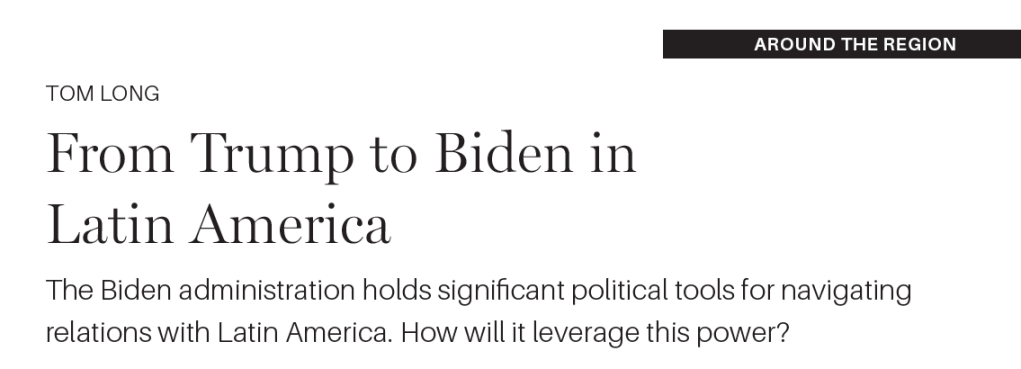
My short policy essay appears in the newly published issue of the NACLA Report on the Americas. The article gives a broad overview of US-Latin American relations at the current conjuncture, with particular attention to the transition to Biden. It’s set in a broader assessment of the state of US power in the Western Hemisphere today.

The new administration of President Joseph Biden is more rhetorically attuned to Latin American concerns, both because of the makeup of his team and Biden’s own longstanding connections to regional leaders. As a young senator, Biden cut his teeth in the battles over human rights and the 1978 Panama Canal treaties, which gradually returned the canal and adjacent lands to Panama’s control. Later, he emerged as a strong advocate for Plan Colombia, and the government of Colombian President Andrés Pastrana saw him as an ally. As vice president, Biden spearheaded the Obama administration’s economic dialogue with Mexico and its security and migration approach to Central America. Now, his team includes committed multilateralists and liberal internationalists in prominent positions, as well as seasoned Latin American policy hands and Latinx officials.

For all those reasons, there is little doubt that Biden’s discourse will re-bury the Monroe Doctrine. Will his policy do so as well?

Access the full article below. Please use your institutional access with the first link if you have it, or access a free copy (while they last) with the second. Thanks for reading, and comments are welcome!

New book chapters

I was very pleased to have chapters in two new edited volumes released in April.

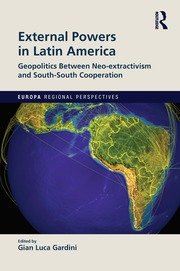
This chapter, written as a broad survey with teaching needs in mind, gives a short and synthetic account of US-Latin American relations over two centuries. The book includes chapters on Latin America’s relations with countries across the world.

  • “The United States in Latin America: Lasting Asymmetries, Waning Influence?” in Gian Luca Gardini, ed., External Powers in Latin America: Geopolitics between Neo-extractivism and South-South Cooperation.
    (Routledge), pp. 15-28.

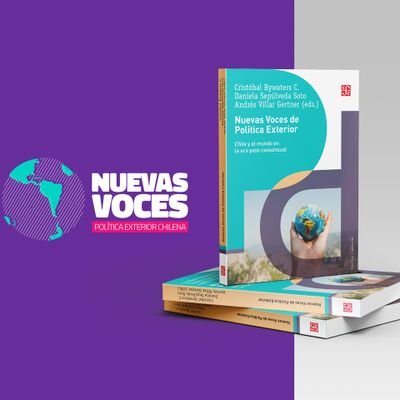
This book is causing a stir in Chile and is edited by my doctoral student Cristóbal Bywaters and colleagues. It proposes a new and progressive vision for Chile’s place in the world during a moment of social, political, and constitutional change.

  • “Chile en la convergencia de las crisis,” in Cristóbal Bywaters, Daniela Sepúlveda Soto, Andrés Villar, eds. Nuevas voces de política exterior: Chile y el mundo en la era post-consensual (Santiago, Chile: Fondo de Cultura Económica), pp. 59-69.