New article in International Organization

My new article, co-authored with Carsten-Andreas Schulz of Cambridge University, has been published by International Organization. IO is perhaps the most prestigious outlet in the field of International Relations, and I’ve dreamed of publishing there since first finishing my PhD. The article, entitled “Compensatory Layering and the Birth of the Multipurpose Multilateral IGO in the Americas,” emerges from our AHRC-funded research on Latin America and the formation of international order. In the piece, we illustrate the innovations that led to the creation of the world’s first multipurpose, multilateral international organization–a form associated with the League of Nations and the United Nations. The first such body was the Pan American Union, which developed between 1890 and 1910 through a series of bargains between the United States and Latin American states. The article builds a bridge between Global International Relations and the study of institutional design, while also advancing institutionalist understanding of the design and development of IOs.

We’re beyond thrilled to see this piece online and eventually in print. We started working on it in mid-2019, initially for a workshop at Johns Hopkins University, and it was a long road with pandemic-related disruptions pushing our revisions back by nearly a year. It’s an honor to be in the pages of International Organization! Abstract below the image.

The Pan American Union building, located just off the national mall in Washington, DC.

Abstract

International organizations come in many shapes and sizes. Within this institutional gamut, the multipurpose multilateral intergovernmental organization (MMIGO) plays a central role. This institutional form is often traced to the creation of the League of Nations, but in fact the first MMIGO emerged in the Western Hemisphere at the close of the nineteenth century. Originally modeled on a single-issue European public international union, the Commercial Bureau of the American Republics evolved into the multipurpose, multilateral Pan American Union (PAU). Contrary to prominent explanations of institutional genesis, the PAU’s design did not result from functional needs nor from the blueprints of a hegemonic power. Advancing a recent synthesis between historical and rational institutionalism, we argue that the first MMIGO arose through a process of compensatory layering: a mechanism whereby a sequence of bargains over control and scope leads to gradual but transformative institutional change. We expect compensatory layering to occur when an organization is focal, power asymmetries among members of that organization are large, and preferences over institutional design diverge. Our empirical and theoretical contributions demonstrate the value a more global international relations (IR) perspective can bring to the study of institutional design. international relations (IR) scholars have long noted that international organizations provide smaller states with voice opportunities; our account suggests those spaces may be of smaller states’ own making.
Article covered in FT

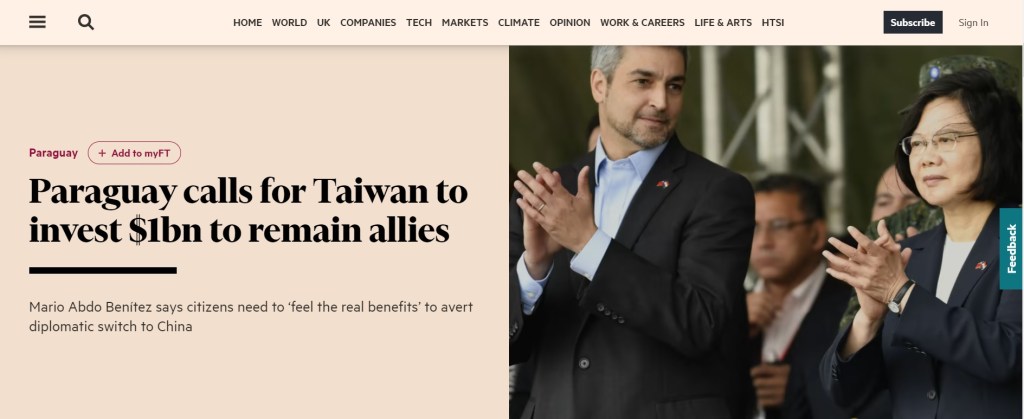
My 2021 Foreign Policy Analysis article with Francisco Urdinez received some welcome attention from the Financial Times yesterday. The article drew on an interview with Paraguay’s president about the increasingly uncommon bilateral relationship, and noted our research on the opportunity cost that recognizing Taiwan appears to have incurred during the “China boom.” Paraguay is the only country in South America to recognize Taiwan over China; under the “One China” policy, third countries face an either/or decision between the two governments.

Although President Abdo is evidently seeking greater material benefits to placate domestic pressures for investment and markets (especially for agricultural goods), we argue that material benefits alone don’t explain Paraguay’s continued recognition of Taiwan. Today, the relationship between the long-dominant Colorado Party and the United States is increasingly shaky, creating another headwind for Paraguay’s pro-Taiwain faction. Still, Abdo offered quite strong support for Taiwan at the UN General Assembly, so the relationship appears to have some life.

Many thanks to editor Michael Stott at the FT for his interest!

Presentación de libro en El Colegio de México

Ha sido un gran honor presentar mi segundo libro, Los Estados Pequeños en la Política Internacional, hoy en El Colegio de México. Es la primera vez que he tenido la oportunidad de dar una conferencia en español acerca del proyecto. Agradezco mucho la oportunidad, la invitación de Celia Toro y Élodie Brun, la asistencia y participación de excelentes estudiantes y profesores. ¡Gracias! Está disponible en YouTube, en la página de El Colegio.

Si les interesa, el libro está disponible directamente de Oxford University Press o a través de Amazon y otras páginas.

North America news

Over the last several years, I have been involved in a few projects related to North American cooperation. These will be leading to a number of publications and other activities in the months and year ahead.

First, I’ve had a brief published yesterday on “North America and the World.” The paper is part of the Woodrow Wilson Center’s series Strengthening North American Ties, edited by former US Ambassador to Mexico Tony Wayne. North America is often overlooked as a world region, especially compared to those with more active regional organizations. However, there is an important reason for giving North America a greater global profile, in my view.

Second, also with the Wilson Center, I have been coordinating and co-editing a book on policy issues for North America today. It’s called North America 2.0: Forging a Continental Future. I’ve been working closely with Alan Bersin, who has worn many different policy hats in the past. The volume will include sixteen substantive chapters from some three dozen contributors. Those authors include a wide range of experts, academics, former diplomats, military officials, private sector representatives, and policymakers. The book should be published in October by the Wilson Center Press, so more updates soon!

Finally, I continue my role as chair, co-coordinator and co-editor (all with Eric Hershberg) of a more academically focused research network: the Robert A. Pastor North American Research Initiative. We have just finished the text for an editing volume resulting from this collaboration, which will be published next year by the University of New Mexico Press. It will be called, North America: Stagnation, Decline, or Renewal? You can see the Table of Contents below. The initiative also led to my recent article in Global Studies Quarterly on public attitudes on regional cooperation in Canada, Mexico, and the United States.

Atlantic Council: Ukraine and the Global South

Yesterday, I joined an online panel at The Atlantic Council to discuss the diverse responses from small states, Latin America and the Caribbean, and the Global South more broadly to the Russian invasion of Ukraine. There has been much comment, and some derision, regarding the ambiguity or lack of condemnation of the invasion from the world beyond NATO. In this panel, we discuss why that might be the case, and how US foreign policymakers should respond.

More information on the panel and panelists is available here, or you can watch the panel on YouTube above.

If you find the panel of interest, you might want to check out A Small State’s Guide to Influence (Oxford University Press, 2022). It’s available from OUP directly, with the discount code ASFLY06, via Amazon on Kindle or hard copies in the US, or via many fine booksellers.

Promotion to Reader

In the last few days, I’ve received the formal announcement that I’ve been promoted to Reader!

For those in North America, that’s probably rather cryptic. After all, those who know me also know that I’ve been doing a lot of reading for quite a long time. At Warwick, though, Reader is a title between associate professor and full professor (or “chair”); it’s something of a half-step like “senior associate professor.” Unlike in the US, in the UK, I still am not permitted to use the title “professor”!

In the traditional UK academic hierarchy, the career path went Lecturer, Senior Lecturer, Reader, Professor. Many British universities, Warwick included, have changed from “lecturer” to assistant professor and associate professor. A few, again including Warwick, have retained Reader as a legacy; it’s a non-required half-step between associate and full professor.

(I’m not entirely sure about why these changes have happened, but I suspect that as the academic job market became increasingly global, North American applicants shunned “lecturer” positions because that term is associated with a lower, non-permanent rank in many US universities. Just a guess.)

Anyhow, I am looking forward to the new business cards. A big thanks to my colleagues at PAIS for their support in the process, to my friends and mentors at American University, to the six anonymous professors who provided external references, to friends, coauthors, and colleagues around the world. And a big thanks to Marta, Sophie, Mom and Dad.

New America event recording: Small States in IR

Thanks to the teams at New America and Bridging the Gap for hosting a great discussion on small states in International Relations. The conversation featured discussion of my new book, A Small State’s Guide to Influence in World Politics, with scholars and practitioners. Thank you to Professor Jim Goldgeier of American University, Dr Emily Wilkinson of ODI, and Wazim Mowla of the Atlantic Council for joining.

The book is available in the Western Hemisphere in paperback via Oxford University Press and as an ebook on Kindle via Amazon worldwide. The hard copies in the UK and EU have been delayed due to issues at the printer, but they should be out soon!

Online book panel

New America, a Washington-based think tank, has organized a panel discussion on small states in international relations framed around my new book, A Small State’s Guide to Influence in World Politics.

The event is 1:30-2:30 Eastern Time, May 4, 2022. It includes some stellar speakers: moderator Professor Jim Goldgeier, Wazim Mowla of the Atlantic Council, and Dr Emily Wilkinson of London-based ODI. And I’ll be joining, too.

You can register for the event here.

Book discount: Small State’s Guide to Influence in World Politics

Oxford University Press is offering a special discount on my new book, A Small State’s Guide to Influence in World Politics. You can order direct here, through OUP, and add the discount code.

The book shows why small states matter to International Relations theory and practice, offers an account of when and how small states can gain influence, and includes a global range of cases regarding small states and international security, international political economy, and institutions, laws, and norms.

First book talk! Ashoka University

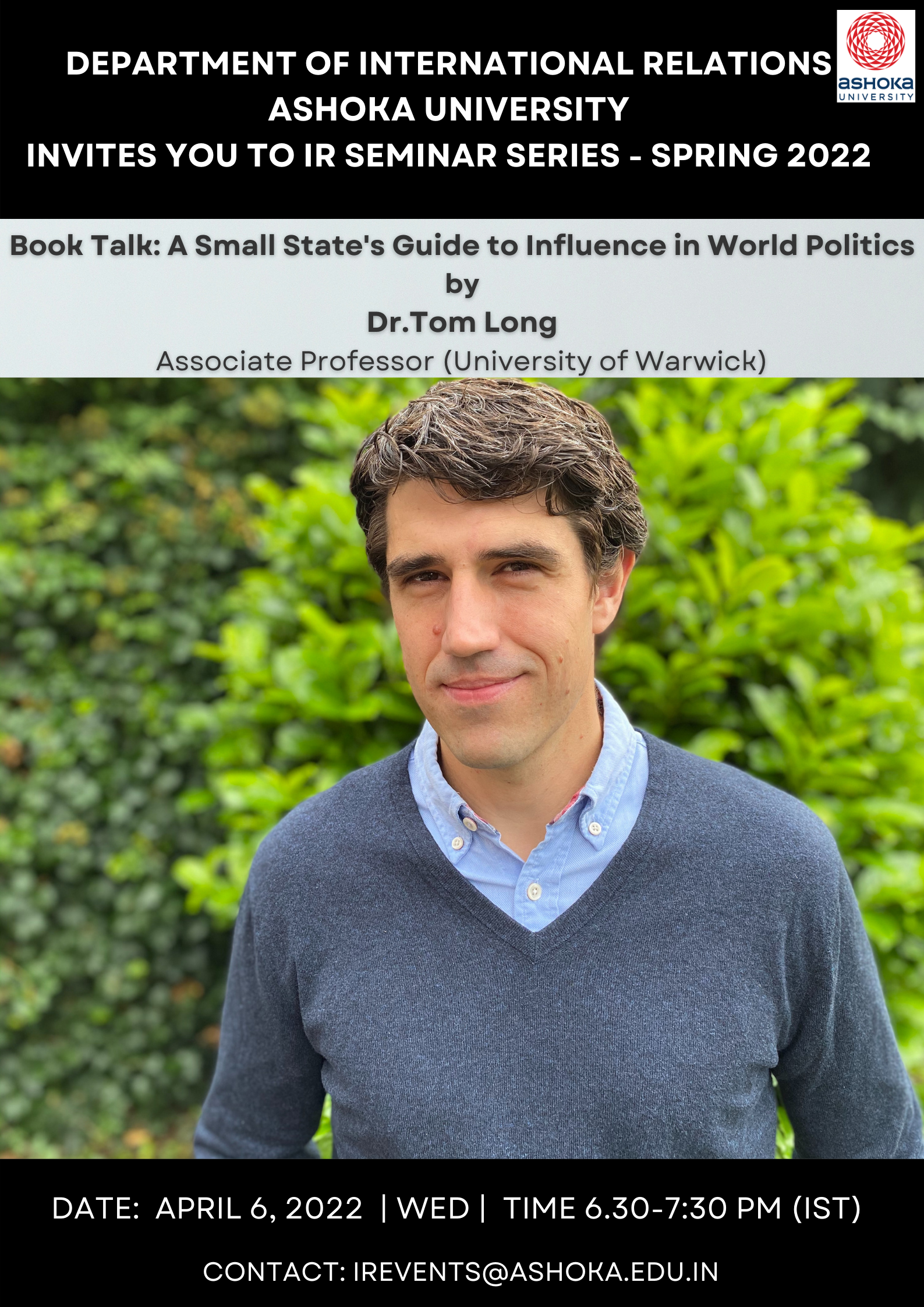
I’m very pleased to be giving my first book talk for A Small State’s Guide to Influence in World Politics at the Department of International Relations at Ashoka University, outside of Delhi, India. Thanks to Dr. Deep Pal and Dr. Quintijn Kat for the virtual invitation–though I would have enjoyed joining you in Delhi!

The talk is open to external attendees, though you need to email the address on the poster above to register. (Posting a link to a talk seems to inevitably attract zoom-bombers and other miscreants.)

I am happy to give book talks, online and in-person, now that the book is out in the US and as an ebook. The book will be out in print in the UK, Europe, and (hopefully) other countries (including India!) after May 5. If you are interested in having me discuss the book in a seminar, class, or other forum, just send me an email.