Forthcoming: It’s Not the Size, It’s the Relationship*

ipI’m glad to say that I have a new article accepted for publication at the journal International Politics, which is edited by Michael Cox at the London School of Economics. IP is a great, lively journal that publishes relatively short, engaging (and often argumentative) pieces. It is (I think) gaining prominence in the UK and elsewhere. They recently had a great special issue on responses to regional powers that is very relevant to anyone interested in regionalism or the role of Brazil in South America. My CIDE colleague Mark Aspinwall also published a great, counter-intuitive article about Mexican influence on U.S. drug policy in the journal a few weeks ago.

My own article certainly seeks to fit the journal’s argumentative mode. It is titled “It’s Not the Size, It’s the Relationship: From ‘Small States’ to Asymmetry.” The basic thrust of the argument is as follows: decades of debate over how we should define the term “small state” has not produced much consensus (everyone agrees on this). Furthermore, the debate has had some negative consequences, like limiting theory-building, comparison, and two-way conversation with IR theory. Instead, I argue that we should more fully embrace a relational approach that places small states within the context of asymmetrical relationships instead of treating them as a coherent category.

I don’t have a publication date or link yet, but I will update when I do.

*Intentionally sophomoric title. But it actually makes sense!

Forthcoming: Coloso Fragmentado

17094Good news! I have a forthcoming article in Foro Internacional, published by the Colegio de México, in early 2017. It is titled, “Coloso fragmentado: The ‘intermestic’ agenda and Latin American foreign policy.” The review process was quite positive, with good suggestions from the anonymous reviewers. It will be out in Foro Internacional 227 (vol. LVII-1, enero marzo de 2017). There is a bit of delay because I wrote the piece in English, and Foro is graciously handling the translation for me. So, if you have something you would like to publish to engage with a Spanish-language audience, I would recommend it, even if you don’t want to (or can’t) write it in Spanish. Here is an abstract:

Abstract: “Intermestic” issues, including trade, migration, and drug-trafficking, dominate contemporary U.S.-Latin American relations and matter deeply to Latin American and Caribbean states. Despite their importance to Latin American leaders and publics, Latin American diplomats have had less success influencing U.S. policy than in other spheres. These failures owe, at least in part, to the dynamics that intermestic issues create in the U.S. foreign policy process. While those dynamics have been broadly explored, there has been less attention to the ways in which these dynamics affect Latin American and Caribbean foreign policy towards the United States. Building on work by Putnam, Milner, Tsebelis, and others, this article argues that intermestic issues have more veto players and narrower win-sets than traditional foreign policy issues, which complicates attempts at influencing U.S. policies. The argument is examined against the case of the U.S.-Mexico cross-border trucking dispute, where the Mexican government struggled with U.S. officials and interest groups for two decades to gain U.S. compliance with NAFTA. After briefly exploring other relevant issues, the article suggests that for Latin American policymakers, intermestic issues demand different diplomatic strategies.

Keeping up with CIDE

cide_vidrio-midI have the very happy news that I have been appointed profesor afiliado  with the Division of International Studies at the Centro de Investigación y Docencia Económicas in Mexico City. I can’t speak highly enough of the team there, and my year at CIDE was highly productive. The DEI is full of incredible scholars who are also wonderful people. This is a great way to maintain my ties with wonderful colleagues, facilitate research projects, and to have an institutional home in Mexico. I am honored to continue being a part of the CIDE family, even from a bit farther away (though honestly, a pesero from Condesa to Santa Fe sometimes felt like a trans-Atlantic flight). Thanks to the DEI and CIDE for the vote of confidence.
 

ISA 2016 Round-up

I spent last week at the 2016 International Studies Association conference in Atlanta. I am finding every ISA a little more beneficial, as I move away from being a grad student who feels like a bit of a supplicant to being an established “early career” scholar. That is, it is much nicer to be able to refer to past publications and ongoing projects than to always be talking about one’s dissertation and hoping to meet people on hiring committees.

isa_international_studies_associationISA was particularly useful this year, my first traveling from the UK to participate. On the one hand, it gave me the chance to catch up with many Washington contacts, which was professionally beneficial and personally gratifying. It’s wonderful that American University has such a presence. ISA feels a bit like homecoming, and that’s special when you are an ocean away. On the other, I had a great excuse to introduce myself to people from all over the UK, with whom I might be able to collaborate, but whom I might not usually meet here. The Bridging the Gap project has provided another, related, home at ISA. I am bumping into BtG folks wherever I go, and the community active and welcoming.
ISA is truly international, and I had many useful conversations with colleagues from CIDE and ColMex in Mexico City, from Los Andes in Bogota, from PUC in Rio, to name just a few. The Latin American participation appears to be growing (though I would love to see some numbers), despite some pretty obvious currency and fiscal pressures for many institutions there. I think there is growing interest in IR in Latin America and an increasing quality and professionalization at many Latin American universities (something in great evidence at CIDE, of course). The grad students I met from Latin America were also top notch. Perhaps the largest crowd for any panel I attended was for an 8:15 am panel on Latin American foreign policy. The papers were great and the discussion even better.

I presented a paper on asymmetry and small states in International Relations, with the great privilege of having many of the key authors I was citing (and at times arguing with) on the panel and in the audience. Again, it was a productive engagement that I think will lead, most directly, to a follow-up panel and, a bit later, to additional collaboration.

In grad school, I was a bit of a conference-skeptic, but at this point, I am already looking forward to ISA 2017. I assume the call for papers will go out in about a week…

Middle Power Regionalism in the Americas

Many thanks to the British Academy and Leverhulme Trust, which have recently decided to support my future research with a “small research grant.” It might not be big money in terms of the UK academic grant world, but it is big to me. The grant will support two trips to Brazil (one to Rio and one to Brasilia) for archival research over the next 18 months. In the nearer-term, the research will contribute to an article project that I am working on with the exceptionally talented historian Max Paul Friedman, as well as to an early theoretical piece on the interplay between middle power foreign policy strategies and the development of regional organization. In the longer term, this research forms part of a book project that explores the historical trajectories of Brazil’s and Mexico’s approaches to regionalism in the Americas starting from the late days of the Second World War until the present. I started work on the Mexican side while at CIDE, and I worked in the State Department archives during my last couple months in Washington.

For anyone who might be interested, my project description is available below the jump.

1142948612_f
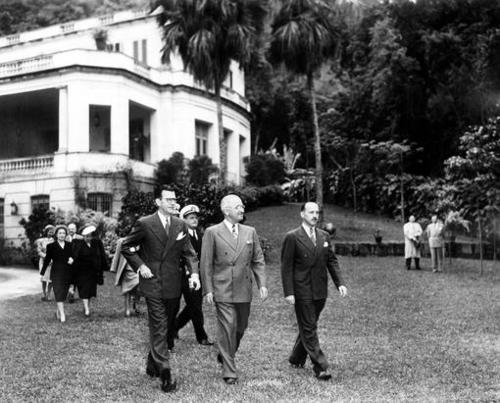
Harry Truman in Rio in 1947


Continue reading “Middle Power Regionalism in the Americas”

Presentation at St Antony’s, Oxford

I just finished a great discussion of Latin America Confronts at St. Antony’s College at Oxford University. It was a real honor to be invited to speak at this wonderful university, founded in 1096. St. Antony’s is one of the younger colleges, and it is known for its international focus in history and politics. St. Antony’s is home to the North American Studies Programme, whose director Hal Jones was gracious enough to invite me. I spoke in the NASP seminar series. The college is also home to an active Latin America Centre, so speaking there gave me the opportunity to meet a number of excellent scholars and students working on the region.

Thanks for all the great questions and comments. Sorry to have prattled on a bit long, leaving less time for them than I should have!

IMG_0810
Photo by Marta Sainz

Peace in Colombia? Lessons from the failed 1999-2002 talks

I have a new article online at the excellent page Latin America Goes Global. There is an excerpt below, but you can read the whole thing at the link above.

266

December 16, 2015

Colombian President Juan Manuel Santos has wagered his legacy on the possibility of peace. He is not the first Colombian leader to do so, but Tuesday’s announcement of an agreement on restitution for the conflict’s victims, following a late September announcement of an agreement on transitional justice, has made it clear that the ongoing talks are making greater headway than ever before.

Santos’ immediate predecessor, Álvaro Uribe, made a very different bet on how to end the country’s five-decade internal conflict. Uribe wielded the military, much improved by U.S. hardware, training and intelligence cooperation, in pursuit of unconditional victory against the Revolutionary Armed Forces of Colombia (FARC). Uribe beefed up and deployed the coercive institutions of the Colombian state to improve the government’s position on the battlefield and re-establish state authority—though according to his critics often in collaboration with paramilitaries and at the cost of respect for human rights, according to Uribe’s critics.

There’s no doubt—despite their current personal spat—that Santos’ peace initiatives build on the success Uribe’s war against FARC. But the Colombian president would do well to look back to the administration of President Andrés Pastrana (1998-2002) who preceded Uribe. Like Santos, Pastrana gambled on a negotiated peace with the FARC. His effort was personal—before his swearing in, he traveled to FARC-held territory to meet the guerrilla leader. While Pastrana’s peace efforts coincided with poor military performance and popular demands for an end to the fighting, it also grew from the leader’s own hope to chart a new path for his country’s political and economic future.

Keep reading at Latin America Goes Global!

Kindle edition available now!

amazon-kindle

Good news!

While we are still waiting for the first hardcover copies of Latin America Confronts the United States: Asymmetry and Influencethe Kindle version is now available from Amazon. You can also download a sample of the book for free to your Kindle or any other device that runs the Kindle Reader program.

The Amazon site also features more information about the book, including some advance reviews from some of the top scholars of U.S.-Latin American relations: Philip Brenner, Abraham F. Lowenthal, and Richard Feinberg. Check it out!

Drugs, Human Rights, Trade, and Distrust

Mexican President Enrique Peña Nieto and U.S. President Barack Obama tried to de-emphasize the role of security in U.S.-Mexican relations, but events made that difficult. Now human rights abuses are a growing concern.

The following article was published today by War on the Rocks. Here’s a brief excerpt from my piece. –TL

Last month, citing human rights concerns, the United States quietly withheld about $5 million in counternarcotics assistance for Mexico. The State Department declined to certify that Mexico met conditions imposed on the aid by Congress under the Leahy Amendment, triggering the 15-percent reduction in funding for Mexican security agencies. Though more than $140 million of other U.S. funding will continue to flow, the decision — first reported by The Washington Post and confirmed by a deputy spokesman at the State Department — was cheered by human rights advocates. A senior official at Human Rights Watch told The New York Times that the cut was “unprecedented.”

The State Department’s decision is symbolically important, but Mexico’s muted reaction was perhaps even more surprising. The Mexican government limited its response to a statement that criticized “unilateral practices,” but painted the aid cut as a consequence of U.S. executive–legislative relations. The focus was instead on the “deep and mature bilateral relationship” between the two neighbors. The muted Mexican reaction is no doubt a reciprocation of the State Department’s low-key handling of the issue and recognition of the fact that most aid money continues to flow, but also a reflection of the evolution of Mexican foreign policy toward the United States. Changes in Mexican politics and the “maturation” of bilateral ties allow U.S. policymakers to give greater weight to human rights without jeopardizing the broader relationship. The United States should use that space to respond to the growing concerns of Mexican citizens about human rights and accountability while reevaluating the failing military-led response to Mexico’s insecurity.

Read the rest over at War on the Rocks.