Some very welcome news after a long, long year…
Alongside my colleague Carsten-Andreas Schulz, we have been awarded a grant from the UK Arts and Humanities Research Council for the project Latin America and the peripheral origins of nineteenth-century international order. The four-year project is funded at £249,996. (I don’t see any of that, of course, but it will allows us to dedicate much of our time to the research project and also support travel, research assistants, conferences, and more.) Carsten is an assistant professor at Pontificia Universidad Católica in Chile; he’s a wonderful scholar and friend. He previously visited Warwick on a fellowship and from the Institute for Advanced Study, after he was instrumental in helping facilitate my time as a Fulbright Visiting Professor in Santiago. In addition to the grant, we’re already working on a couple articles together.
Drawing on multinational archival work, our project will examine Latin America’s role in the development of international order during the nineteenth century. This era has drawn scrutiny in historical International Relations for the illiberal and imperial practices that accompanied the emergence of a ‘liberal’ international order. Latin America often occupied a distinct place as a group of sovereign states that was accorded lesser status by European powers. However, Latin America’s own vibrant republican institutions spurred vital contributions to international practices, norms, and institutions. Latin America’s engagement shaped international order in lasting ways that should shape our understandings of the ‘crisis’ if international order today. Long and Schulz will examine the roots of these contributions—and the ways international order influenced domestic hierarchies—in research in Argentina, Brazil, Colombia, Mexico, and the United States.
The project has several inspirations, but in part it seeks to develop an international counterpart to the work on republicanism and liberalism in Latin America’s nineteenth century by historians including Hilda Sabato, James Sanders, Eduardo Posada-Carbó and Iván Jaksic, Guy Thomson, Erika Pani, Marixa Lasso, Peter Guardino, Cristina Rojas, Muriel Laurent, Michel Gobat, Nichola Miller, and more. We are lucky to count Posada-Carbó, Sabato, Pani, Laurent, Thomson, Louise Fawcett, and Matias Spektor as members of our all-star advisory board.
Officially, the project starts in September, but if you look at my reading list, it is already under way! If you would like to learn more, the project summary is below, and I would be glad to discuss. We are also welcoming recommendations for readings, archival sources (especially digitized, given current conditions!), and possible collaborators.
AHRC project summary

Debates about the state of the international order have leapt from academic journals to the front pages of newspapers and into the discourses of policymakers concerned about sustaining cooperation to address global challenges. International order-a complex of international norms, institutions, and practices that helps structure world politics-is understood to be challenged from without by the rise of new powers and weakened from within by a hollowing out of support from key states. This attention has driven scholarly attempts to better understand international order’s foundation and evolution-and to criticize assumptions of that order’s beneficence.
Many of the norms, institutions, and practices that underpin today’s order emerged in the nineteenth century; the great power bargains that shaped the order were intertwined with the expansion of empires and imposition of racial hierarchies. Scholarship in both global history and international relations increasingly understands the nineteenth century as a pivotal moment in the development international order. This project seeks to better understand the role of Latin America in this process-how did Latin American states shape and how were they shaped by their interactions with these foundational international projects? Given its status during this period-mostly independent but bereft of great powers and marginal to European international society-Latin America has been largely absent from discussions of international order or seen through the lens of their relations with the United States. This absence matters if we want to better understand how projects of international order relate to countries outside their cores. Our research will further de-center understandings of international order’s creation and examine the constraints and possibilities for peripheral influence.
The period was also pivotal for Latin American state consolidation and international insertion. Latin America was long
presumed to be an illiberal backwater during the nineteenth century; however, recent scholarship of the history of political ideas has shown the vibrancy of liberalism and republican projects and practices. Legal history, in turn, has emphasized the relevance of legal traditions and the way in which they informed state formation and international relations. However, we still know little about how domestic and international practices were connected; as such we propose the examination of “Latin America republican internationalism” as a lens through which to examine how domestic politics were manifested in diplomatic practice. The research will benefit global historians, international relations scholars, and historians of republicanism and liberalism in Latin America’s nineteenth century.
The project will examine these developments from 1864-1919 through original archival research in Argentina, Brazil,
Colombia, Mexico, and the USA. We will focus on key moments, such as international and regional summits and the
creation of international organizations, and re-engage the region’s international intellectual currents. We seek a better
understanding of how republicanism and liberalism shaped Latin American diplomatic practices, how Latin America’s
peripheral position affected its engagement with projects of order-building, and how its proposals may have influenced practices of multilateralism. The initial period starts with the First Geneva Conference and is marked by the growing domestic consolidation and international economic insertion of Latin America. At a global level, it was characterized by early creation of international public unions and larger projects of inter-imperial international order-building. From about 1889, we enter a second period in which disparate diplomatic initiatives begin to coalesce into forms that resemble today’s international organizations. Many of these bodies exist today or have been reborn in the post-Second World War institutional architecture.



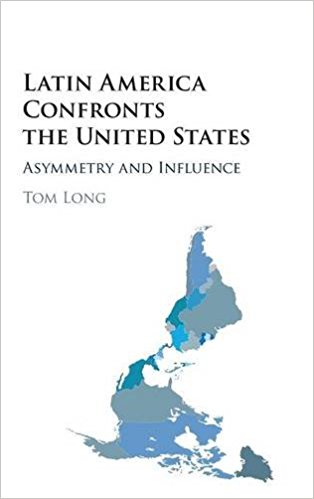 I woke up this morning to learn that my book, Latin America Confronts the United States (Cambridge University Press, 2015) was included in a new Latin American Research Review essay by Dexter Boniface. It’s a great essay, which offers a helpful assessment of the field and discusses several interesting recent books:
 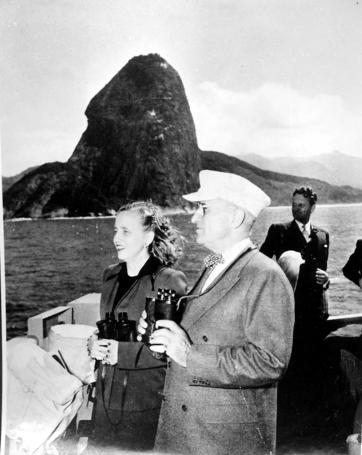 Substantively, the article explores Latin American contributions to emerging security orders in the late 1940s. There’s some classic work on this era’s influence in domestic Latin America politics (e.g., Bethell and Roxborough), but the multinational archival work on foreign relations remains pretty thin. Theoretically, it engages with IR debates about regional variation in postwar orders, connecting to debates on comparative regionalism and the “Why is there no NATO in Asia?” debate launched by Hemmer and Katzenstein nearly fifteen years ago. Methodologically, it employs historical institutionalism’s conceptual tools to offer a more systematic explanation of how “history matters” in the formation of international institutions. This meant really diving into the dynamics and logics of critical junctures, as well as mechanisms for change in historical institutionalism (layering and conversion, especially).
 Our answer is two-fold. Internationally, the Paraguay-Taiwan relationship creates status benefits. Those benefits are asymmetrical, but valued by each side. However, this is status “at the margins” of international society, and it differs in important respects from the types of great-power-centric status that receive the most attention in IR. There’s also an important story about the domestic foundations: elite structures in Paraguay allow for concentration of material and immaterial status benefits, while also shaping a narrow and conservative foreign policy decision-making structure. I got to delve into research about de facto states, recognition and international-legal sovereignty, and small states and status, all of which helped me think through this bilateral relationship in new ways.
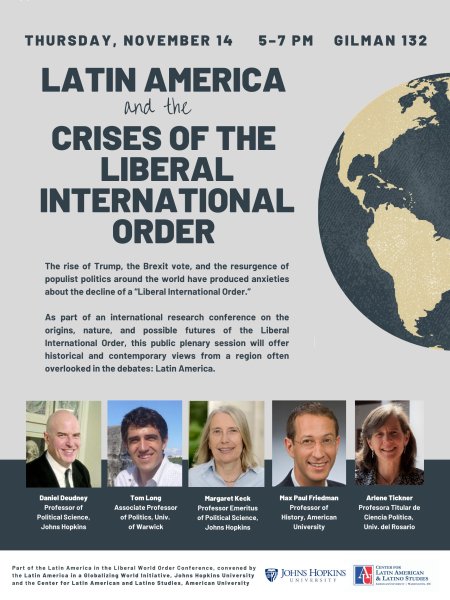 The first night started with an all-star (plus me) panel. I found myself sitting between Daniel Deudney–who perhaps co-coined the term “liberal international order” in 1998 with John Ikenberry–and Margaret Keck, whose work with Kathryn Sikkink reshaped IR’s approach to human rights and transnational activism. Down the row, my mentor and friend, the brilliant and always eloquent Max Paul Friedman, who followed Voltaire’s quip about the Holy Roman Empire but questioning whether the liberal international order was actually, liberal, international or orderly. Next to Max, Arlene Tickner of Colombia’s Universidad del Rosario, who is one of the most influential voices and advocates for IR scholarship that is inclusive of the Global South and its scholars. And Christy kept things moving with insightful questions.
 Tom Long, PhD