 My newest article is just out as part of a special issue of the journal Contemporary Politics, vol. 24, no. 1. The issue came out of a workshop at the College of Europe, called Between cooperation and competition: major powers in shared neighbourhoods. The workshop and issue were organized and edited by Simon Schunz, Sieglinde Gstöhl & Luk Van Langenhove, who did a great job putting this all together. The whole special issue is available here.
My article looks at US-Brazilian interactions in Latin America, drawing on and extending Brantly Womack’s asymmetry theory (abstract below). Routledge allows me to offer free access to my own article for the first 50 readers through a special link, available for a limited time here. Please help yourself to a free copy, while they last–on the condition that you cite it copiously, of course!
Abstract: Until its recent crisis, Brazil’s rise, combined with seeming US decline and distraction, led observers to declare South America a ‘post-hegemonic’ region. How have US and Brazilian ambitions and capabilities affected the countries’ relations within the shared neighbourhood of the Western Hemisphere? Building on work by Womack, B. [2016. Asymmetry and international relationships. New York: Cambridge University Press], the article analyses the US-Brazil-South America relationship as a regionally located, asymmetrical triangle. During two centre-left presidencies, Brazil sought to shift the dynamics of the hemisphere’s soft triangles. Brazilian diplomacy redefined its neighbourhood as South America, developed exclusive regional groupings, and assumed the role of pivot to shape relationships between the US and South America. In the face of sceptical neighbours and weakened Brazilian capabilities, the regional triangle is likely to return to a more ‘normal’ configuration in which the United States acts as a central, albeit often uninterested, pivot.
 (belated post) I talked to
  I reviewed Hal Brands’s intriguing Making the Unipolar Moment for Political Science Quarterly. The review has been published as part of the fall issue, and
  My book Latin America Confronts the United States has just been released in paperback from Cambridge University Press. And it’s on sale on Amazon!
  My chapter “Regional public goods in North America,” with Manuel Suárez-Mier, was just released in the book 21st Century Cooperation: Regional Public Goods, Global Governance, and Sustainable Development,
  I have a new, general audience article with Max Paul Friedman on the International Security Studies Forum. They have been running a policy series on different aspects of U.S. foreign and security policy today.
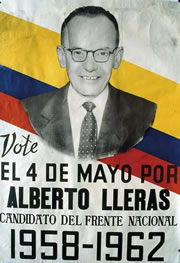 I reviewed Princeton historian Robert Karl’s very good article on the intersection of the Cuban Revolution and Colombian domestic politics. The review was published today on the H-Diplo forum. In the review, I write:
 Tom Long, PhD