Book review: Kalman Silvert

I recently returned from the Latin American Studies Association conference. It was a landmark event for LASA — the 50th anniversary of the organization’s founding, the largest and most international conference ever, and a return to New York after decades away. One of the benefits of LASA, particularly now that I am living in the UK, is the opportunity to catch up with many of my past professors and mentors.

IMG_20160611_193716
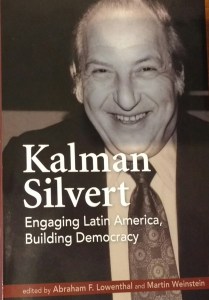
A new book on Kalman Silvert, edited by Abraham F. Lowenthal and Martin Weinstein, who like most of the contributors were former students, colleagues, and mentees of Silvert.

One of them, Louis Goodman, former dean of the School of International Service, gave me a copy of a book, Kalman Silvert: Engaging Latin America, Building Democracy, shortly before the conference (published by Lynne Rienner). The volume, to which Goodman contributed, was compiled and edited by Abraham Lowenthal and Martin Weinstein. Before getting the book, I knew Silvert’s name in large part because LASA’s highest prize is named after him. I would have been hard pressed to tell you too much more. As the book itself notes, Silvert’s contributions have somewhat faded from view. His writings are not widely cited. He is well remembered by a senior generation, but largely unknown to my own generation.

Silvert was a founder and the first president of LASA. He was a professor at Tulane, University of Buenos Aires, Dartmouth, and NYU. He also was a senior advisor for the Ford Foundation’s programs in the social science, with a focus on Latin America during a crucial time. He worked to support social scientists living and working in repressive regimes in the 1960s until his death in 1976. Support from Ford helped numerous institutions in Latin America provide a venue for independent social science under trying circumstances. Through his scholarship, teaching, and development of professional networks, Silvert pressed for individual rights, education, democracy, and better relations between the United States and Latin America. He was deeply involved in the creation of many institutions that for my generation have always formed the professional landscape of Latin American studies.

The book offers an excellent introduction to Silvert’s life and work. Chapters offer an overview of his major works, contributions on mentoring, through philanthropic organizations, as a public intellectual, and engagement with U.S. policy–particularly through the Commission on United States – Latin American Relations, often known as “the Linowitz Commission,” which had a major influence on the Carter Administration’s approaches to Latin America.

The book is also a wonderful reminder that so much of what we do goes beyond our writings. Most of the chapters are contributed by Silvert’s former students or by scholars he worked with closely across Latin America, though especially in Argentina and Chile. The chapters weave together many interlocking aspect’s of Silvert’s life and work, and they also serve as a wonderful reminder that the social sciences are social in more ways than one. These personal relationships are, of course, important to how we build knowledge, but they are usually invisible in our published work. This is an excellent corrective.

Looking forward to LASA 2016, NYC

cfnxppmumaet4jfThe 2016 Latin American Studies Association conference is right around the corner, and I am looking forward to participating. This year, I will be giving a paper called “The United States and Latin America Decline of power or decline in interest?” on a panel on Sunday at 2:30. The panel, organized by Laura MacDonald of Carleton, is called “The Role of External Actors in Post-Hegemonic Latin America.” My paper (abstract below) sort of starts with asking, “how ‘post-hegemonic’ is the Western Hemisphere?” I am also discussant on a panel Sunday evening on “Contentious political issues in contemporary inter-American affairs: from (non)insurgency to international security and trade policymaking,” which includes my friend and superb young scholar Mariano Bertucci of Tulane.

Abstract: It is commonly asserted that the United States no longer holds the dominant position it once did in Latin America. This decline is credited to several factors: a global decline in U.S. power, lower levels of U.S. attention to the region, the entrance of new extra-hemispheric challengers, and more “assertive” Latin American leaders. This paper seeks to test these claims of U.S. decline. First, using a variety of metrics, it will ask whether U.S. power in the hemisphere has declined relative to regional and extra-regional actors. It assesses recent, frequently cited U.S. struggles to exert influence Latin America—that is, relational power—in comparison to the more distant past. The paper concludes that U.S. decline has too often been assumed instead of demonstrated, that when evidence has been provided it has often been anecdotal, and that this evidence actually demonstrates significant continuities. U.S. decline, both relative to extra-hemispheric powers and in regards to states within the region has been overstated, in part because of a tendency to exaggerate U.S. power in the past, a focus on changes, and an underestimation of the continued depth of U.S. military, economic, structural, and ideational power in the region. There have been real changes in the geographic concentration and nature of U.S. power, as well as in the economic role of China. However, these changes are often outweighed by the continuities of relationships that are still defined by asymmetry.

Truman in Rio: How Brazil, Mexico, and the United States Shaped Regionalism in the Americas

I have just learned that the Harry Truman Library Institute has awarded me a travel and research grant to support archival work at the Truman Presidential Library. My work there will focus on the creation of the inter-American system after World War II. I am particularly interested in debates around democracy, sovereignty/intervention, and international organization. The archives there will complement the work that I am doing in Rio de Janeiro this summer (supported by the British Academy/Leverhulme Trust), work I did last fall in Washington, and archival research done previously in Mexico City while a visiting professor at CIDE.

63-1383-53
Harry and Margaret Truman in Rio de Janeiro. Credit: Truman Library

Here are a couple paragraphs from the application that give a sense of the project:

“The creation of the modern inter-American system, particularly the Organization of American States and the Inter-American Treaty of Reciprocal Assistance (Rio Treaty), has usually been explained as an effect of U.S. regional hegemony. On the one hand, this is understandable. The United States, in the closing stages and immediate aftermath of the Second World War, was at the apex of its relative power. In the Western Hemisphere, it had achieved the near-unanimous cooperation of Latin American states with the Allied war effort—with the exception of Argentina. The inter-American system solidified this state of affairs, while also serving to bring the reluctant Argentines into line.

“This project adopts a more multifaceted approach to regionalism. U.S. power and leadership were certainly crucial to the development of the regional system. However, during the creation of the post-war regional institutions, Latin American states—often led by Mexico and Brazil—sought to create a system that provided them an important forum and offered the possibility of greater influence. President Truman recognized those countries’ importance, paying each a visit in 1947, as well as hosting their leaders in Washington.”

The project ties into a couple medium-term article projects, including one with Max Paul Friedman. Eventually, it will all be part of a big book project that looks at Brazilian and Mexican policies toward regionalism and regional organizations over several decades.


Recommendations for U.S.-Latin American Policy

ed-aq851_biden_g_20130604173943A group of more than twenty scholars, many with policy experience, have put together a document offering consensus policy recommendations for the next U.S. president: Recommendations for U.S.-Latin America/Caribbean Policy, 2016 Elections:
Conclusions of Global Americans Working Group.

The effort, ably led by Chris Sabatini, editor of the web magazine Latin America Goes Global, provides an analysis of the current situation in U.S.-Latin American relations. It also offers ideas for how to move forward on security, trade, diplomacy, human rights, the OAS, etc. I am glad to have been involved in this consensus effort, which I think moves the discussion in a positive direction. So far, unfortunately, the campaign’s discussion and portrayal of Latin America and its people has been overwhelmingly negative.

Now is a time for building bridges, not walls, between the United States and its partners and friends in Latin America and the Caribbean. Check out the report here.

Book review

The first review of my book (I think) is online at Post-Western World. Oliver Stuenkel pulls out some lessons from the book for Brazil and other countries hoping to influence Washington.

He writes, “Successfully engaging and influencing the United States will be crucial for Latin America in the coming years — be it vis-à-vis designing policies to combat drug trafficking and organized crime, fighting corruption, or articulating a regional response to deal with China’s growing influence. Latin America Confronts the United States offers a very interesting look back about how Latin America has been able to influence its dominant neighbor in the North.” Check out the review.

Forthcoming: It’s Not the Size, It’s the Relationship*

ipI’m glad to say that I have a new article accepted for publication at the journal International Politics, which is edited by Michael Cox at the London School of Economics. IP is a great, lively journal that publishes relatively short, engaging (and often argumentative) pieces. It is (I think) gaining prominence in the UK and elsewhere. They recently had a great special issue on responses to regional powers that is very relevant to anyone interested in regionalism or the role of Brazil in South America. My CIDE colleague Mark Aspinwall also published a great, counter-intuitive article about Mexican influence on U.S. drug policy in the journal a few weeks ago.

My own article certainly seeks to fit the journal’s argumentative mode. It is titled “It’s Not the Size, It’s the Relationship: From ‘Small States’ to Asymmetry.” The basic thrust of the argument is as follows: decades of debate over how we should define the term “small state” has not produced much consensus (everyone agrees on this). Furthermore, the debate has had some negative consequences, like limiting theory-building, comparison, and two-way conversation with IR theory. Instead, I argue that we should more fully embrace a relational approach that places small states within the context of asymmetrical relationships instead of treating them as a coherent category.

I don’t have a publication date or link yet, but I will update when I do.

*Intentionally sophomoric title. But it actually makes sense!

Forthcoming: Coloso Fragmentado

17094Good news! I have a forthcoming article in Foro Internacional, published by the Colegio de México, in early 2017. It is titled, “Coloso fragmentado: The ‘intermestic’ agenda and Latin American foreign policy.” The review process was quite positive, with good suggestions from the anonymous reviewers. It will be out in Foro Internacional 227 (vol. LVII-1, enero marzo de 2017). There is a bit of delay because I wrote the piece in English, and Foro is graciously handling the translation for me. So, if you have something you would like to publish to engage with a Spanish-language audience, I would recommend it, even if you don’t want to (or can’t) write it in Spanish. Here is an abstract:

Abstract: “Intermestic” issues, including trade, migration, and drug-trafficking, dominate contemporary U.S.-Latin American relations and matter deeply to Latin American and Caribbean states. Despite their importance to Latin American leaders and publics, Latin American diplomats have had less success influencing U.S. policy than in other spheres. These failures owe, at least in part, to the dynamics that intermestic issues create in the U.S. foreign policy process. While those dynamics have been broadly explored, there has been less attention to the ways in which these dynamics affect Latin American and Caribbean foreign policy towards the United States. Building on work by Putnam, Milner, Tsebelis, and others, this article argues that intermestic issues have more veto players and narrower win-sets than traditional foreign policy issues, which complicates attempts at influencing U.S. policies. The argument is examined against the case of the U.S.-Mexico cross-border trucking dispute, where the Mexican government struggled with U.S. officials and interest groups for two decades to gain U.S. compliance with NAFTA. After briefly exploring other relevant issues, the article suggests that for Latin American policymakers, intermestic issues demand different diplomatic strategies.

Keeping up with CIDE

cide_vidrio-midI have the very happy news that I have been appointed profesor afiliado  with the Division of International Studies at the Centro de Investigación y Docencia Económicas in Mexico City. I can’t speak highly enough of the team there, and my year at CIDE was highly productive. The DEI is full of incredible scholars who are also wonderful people. This is a great way to maintain my ties with wonderful colleagues, facilitate research projects, and to have an institutional home in Mexico. I am honored to continue being a part of the CIDE family, even from a bit farther away (though honestly, a pesero from Condesa to Santa Fe sometimes felt like a trans-Atlantic flight). Thanks to the DEI and CIDE for the vote of confidence.


ISA 2016 Round-up

I spent last week at the 2016 International Studies Association conference in Atlanta. I am finding every ISA a little more beneficial, as I move away from being a grad student who feels like a bit of a supplicant to being an established “early career” scholar. That is, it is much nicer to be able to refer to past publications and ongoing projects than to always be talking about one’s dissertation and hoping to meet people on hiring committees.

isa_international_studies_associationISA was particularly useful this year, my first traveling from the UK to participate. On the one hand, it gave me the chance to catch up with many Washington contacts, which was professionally beneficial and personally gratifying. It’s wonderful that American University has such a presence. ISA feels a bit like homecoming, and that’s special when you are an ocean away. On the other, I had a great excuse to introduce myself to people from all over the UK, with whom I might be able to collaborate, but whom I might not usually meet here. The Bridging the Gap project has provided another, related, home at ISA. I am bumping into BtG folks wherever I go, and the community active and welcoming.

ISA is truly international, and I had many useful conversations with colleagues from CIDE and ColMex in Mexico City, from Los Andes in Bogota, from PUC in Rio, to name just a few. The Latin American participation appears to be growing (though I would love to see some numbers), despite some pretty obvious currency and fiscal pressures for many institutions there. I think there is growing interest in IR in Latin America and an increasing quality and professionalization at many Latin American universities (something in great evidence at CIDE, of course). The grad students I met from Latin America were also top notch. Perhaps the largest crowd for any panel I attended was for an 8:15 am panel on Latin American foreign policy. The papers were great and the discussion even better.

I presented a paper on asymmetry and small states in International Relations, with the great privilege of having many of the key authors I was citing (and at times arguing with) on the panel and in the audience. Again, it was a productive engagement that I think will lead, most directly, to a follow-up panel and, a bit later, to additional collaboration.

In grad school, I was a bit of a conference-skeptic, but at this point, I am already looking forward to ISA 2017. I assume the call for papers will go out in about a week…

Middle Power Regionalism in the Americas

Many thanks to the British Academy and Leverhulme Trust, which have recently decided to support my future research with a “small research grant.” It might not be big money in terms of the UK academic grant world, but it is big to me. The grant will support two trips to Brazil (one to Rio and one to Brasilia) for archival research over the next 18 months. In the nearer-term, the research will contribute to an article project that I am working on with the exceptionally talented historian Max Paul Friedman, as well as to an early theoretical piece on the interplay between middle power foreign policy strategies and the development of regional organization. In the longer term, this research forms part of a book project that explores the historical trajectories of Brazil’s and Mexico’s approaches to regionalism in the Americas starting from the late days of the Second World War until the present. I started work on the Mexican side while at CIDE, and I worked in the State Department archives during my last couple months in Washington.

For anyone who might be interested, my project description is available below the jump.

1142948612_f
Harry Truman in Rio in 1947


Continue reading “Middle Power Regionalism in the Americas”